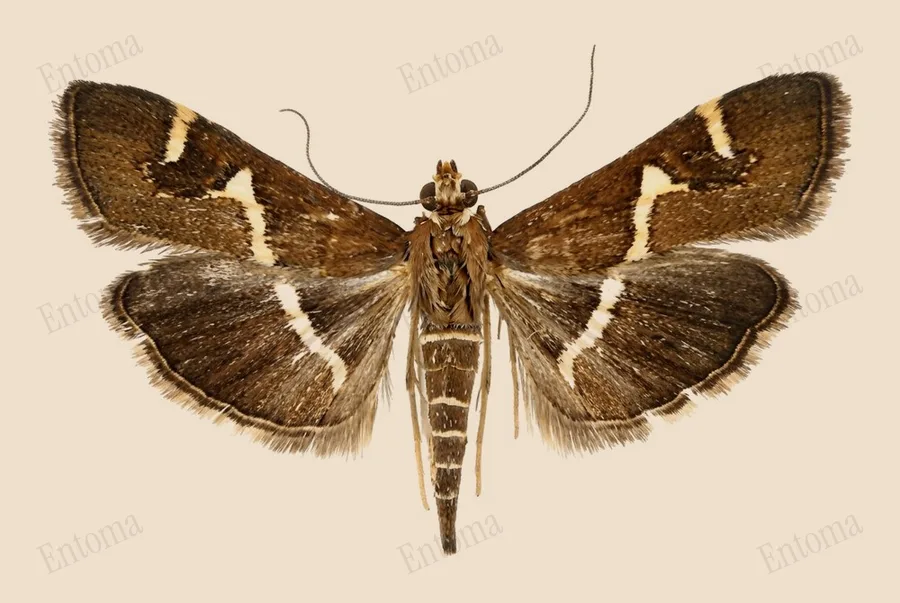
Hawaiian beet webworm moth
This tiny moth can cross entire oceans, turning up on remote islands thousands of kilometres from the nearest beet field its caterpillars feed on.
| Where | Farmland and gardens across East Asia |
|---|---|
| Size | 22 to 24 mm wingspan |
| When | July to November |
This small moth has brown wings crossed by narrow white zigzag bands, a pattern that breaks up its outline when resting on foliage. It is active mainly after dusk and often shelters under leaves by day.
Caterpillars feed on beet, spinach, amaranth and related plants, sometimes in large enough numbers to damage crops. Adults are strong fliers capable of long-distance dispersal, and the species turns up on islands far from any known breeding population.
Traits
Habitat
Farmland
Colour
Brown, White
Active
Night
To people
Harmless to people; its caterpillars are considered a minor agricultural pest on beet and spinach crops.
Activity through the year
Often confused with
Diaphania indica has large translucent white panels on the wings framed by a broad brown border, while Spoladea recurvalis shows narrow white zigzag lines crossing mostly brown wings.
Questions
Is the Hawaiian beet webworm moth dangerous to people?
Harmless to people; its caterpillars are considered a minor agricultural pest on beet and spinach crops.
When can you see the Hawaiian beet webworm moth?
The Hawaiian beet webworm moth can be seen from July to November, at night.
Plate retouched from a museum specimen photo by Taiwan Biodiversity Research Institute, CC BY 4.0, GBIF Licence
Report a mistake in this entry
Butterflies and moths›Grass moths›Spoladea
Last updated 2026-09-27. Every entry is checked against published sources.