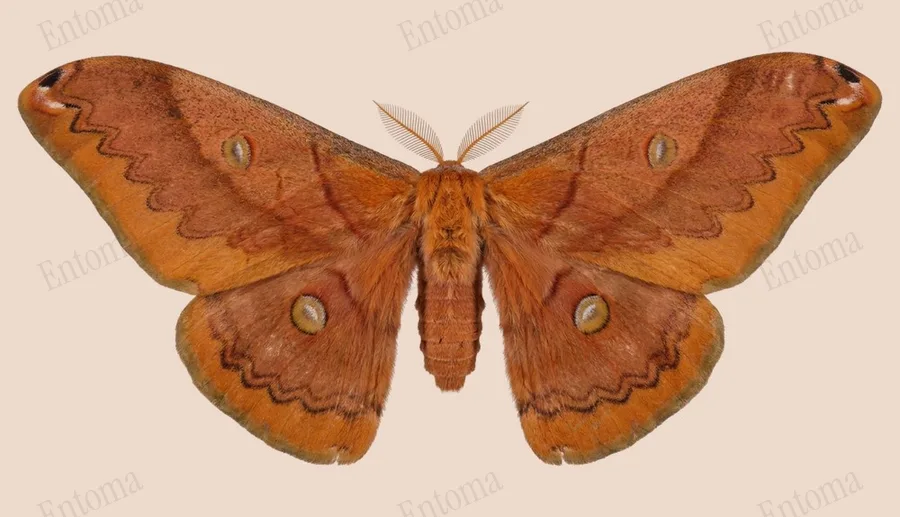
Japanese giant silkworm
Despite its intimidating coat of long white hairs, this moth's caterpillar cannot sting, and the winged adult cannot feed at all, its mouthparts having withered away.
| Where | Broadleaved forests across Japan, China and Taiwan |
|---|---|
| Size | 100 to 130 mm wingspan |
| When | April and June to October |
Rinaca japonica is a large moth with a wingspan of about 100 to 130 mm, its beige to brown forewings dusted with fine short hairs and marked by a pale, crescent shaped mark rather than the round eyespots seen in relatives such as the Japanese oak silkmoth. Males tend to be darker brown with straighter wing margins, while females are paler beige with more rounded wings.
Caterpillars hatch in spring and feed on the leaves of oak, chestnut, walnut, cherry and many other broadleaved trees, growing bluish white and covered in long soft hairs that look alarming but do not irritate skin. They spin a tough, coarsely meshed brown cocoon, and the short lived adults, unable to feed, fly chiefly after dark from late summer into autumn.
Traits
Habitat
Woodland
Colour
Brown, Yellow
Active
Night
To people
Harmless to handle; its long caterpillar hairs look intimidating but do not sting or irritate skin, and the adult moth cannot bite or feed at all.
Activity through the year
Often confused with
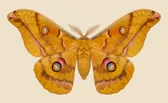
Each wing carries one large, sharply defined eyespot ringed in black, unlike the plain pale crescent mark on the wings of Rinaca japonica.
Flies later in autumn, from October to November, and is whitish yellow or tan with softer markings, rather than the beige to brown, crescent marked wings of Rinaca japonica.
Questions
Is the Japanese giant silkworm dangerous to people?
Harmless to handle; its long caterpillar hairs look intimidating but do not sting or irritate skin, and the adult moth cannot bite or feed at all.
When can you see the Japanese giant silkworm?
The Japanese giant silkworm can be seen from April and June to October, at night.
Plate retouched from a photo by Takaaki Hattori, CC BY 4.0, iNaturalist Licence
Report a mistake in this entry
Butterflies and moths›Emperor moths›Rinaca
Last updated 2026-09-27. Every entry is checked against published sources.