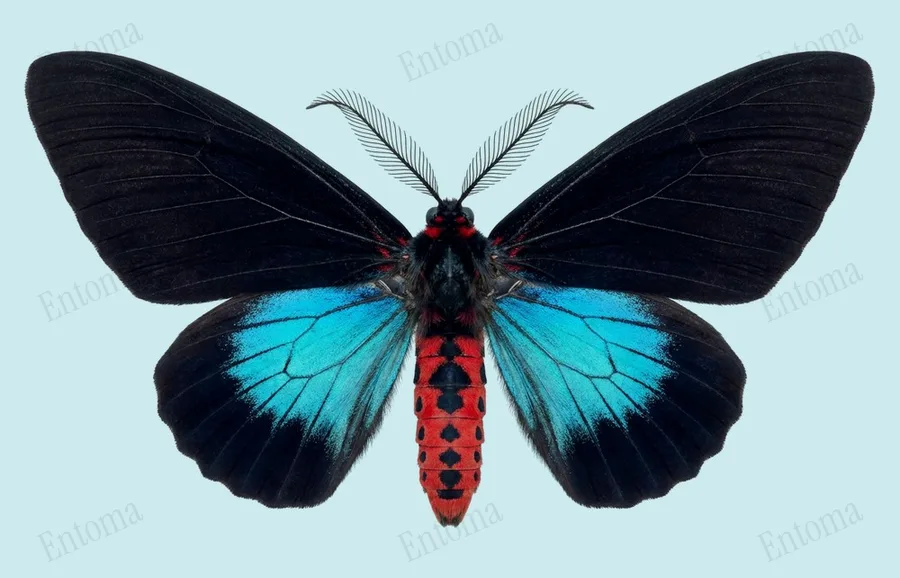
Histia flabellicornis
Disturbed adults of this red and black day-flying moth froth a cyanide-laced fluid from their body as a warning to predators.
| Where | Forests across Southeast Asia and Taiwan |
|---|---|
| Size | 60 to 75 mm wingspan |
| When | January to December |
This diurnal moth has a red body and head set against striking black forewings, a combination that advertises its chemical defences to potential predators.
Caterpillars feed only on the leaves of Bischofia trees and can strip them bare during outbreaks, while both larvae and adults release a foul, cyanide-based froth if handled roughly.
Traits
Habitat
Woodland
Colour
Red, Black
Active
Day
To people
Mild
Adults and larvae release a foul cyanide-based froth if disturbed; not safe to eat and best left alone.
Activity through the year
Often confused with
Forewings are patterned rather than solid black, and the body lacks the bright red colour of Histia flabellicornis.
Questions
Is Histia flabellicornis dangerous to people?
Mild. Adults and larvae release a foul cyanide-based froth if disturbed; not safe to eat and best left alone.
When can you see Histia flabellicornis?
Histia flabellicornis can be seen from January to December, by day.
Plate retouched from a museum specimen photo by Taiwan Biodiversity Research Institute, CC BY 4.0, GBIF Licence
Report a mistake in this entry
Butterflies and moths›Burnet moths›Histia
Last updated 2026-09-27. Every entry is checked against published sources.