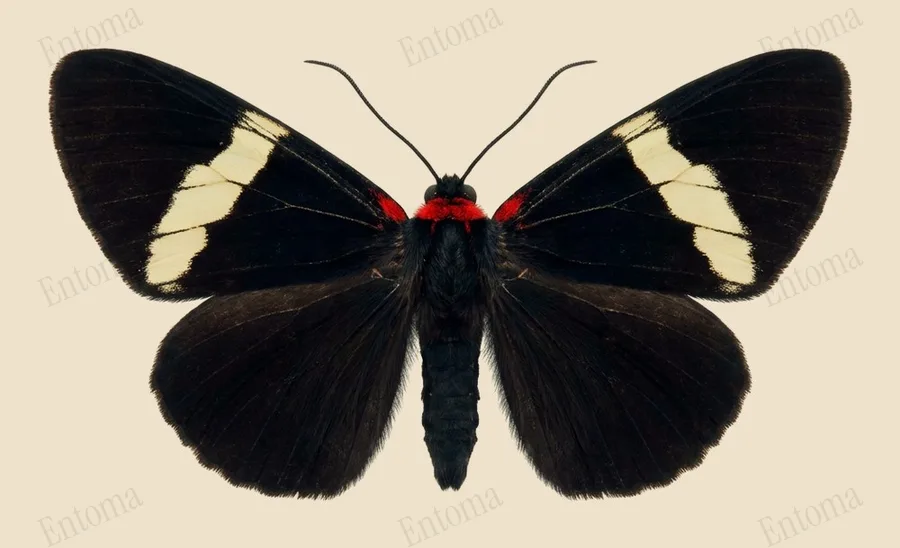
Pidorus atratus
This day-flying moth's black body and red head mimic a firefly, and handling its yellow caterpillars can leave skin itchy for about two days.
| Where | Gardens and woodland edges across Japan |
|---|---|
| Size | 25 to 30 mm forewing length |
| When | May to July and September to October |
This moth flies by day with a glossy black body and a red head and collar, a combination that echoes the warning colours of a firefly rather than copying its light. The wings are black with a faint bluish sheen and it rests with them held flat.
Caterpillars are yellow with grey and black bands and feed on Eurya and Cleyera shrubs, plants often grown as hedging and in temple gardens. The secretion they release when disturbed is not delivered by a sting but can irritate skin on contact.
Traits
Habitat
Garden
Colour
Black, Red
Active
Day
To people
Mild
The adult moth does not sting or bite, but its caterpillars release a mildly irritating secretion that can cause short-lived skin redness and itching.
Activity through the year
Often confused with
The Genji firefly has soft, leathery wing covers over its whole abdomen and glows at night, while Pidorus atratus has typical scaled moth wings held flat over the body and produces no light.
Questions
Is Pidorus atratus dangerous to people?
Mild. The adult moth does not sting or bite, but its caterpillars release a mildly irritating secretion that can cause short-lived skin redness and itching.
When can you see Pidorus atratus?
Pidorus atratus can be seen from May to July and September to October, by day.
Plate retouched from a museum specimen photo by Taiwan Biodiversity Research Institute, CC BY 4.0, GBIF Licence
Report a mistake in this entry
Butterflies and moths›Burnet moths›Pidorus
Last updated 2026-09-27. Every entry is checked against published sources.