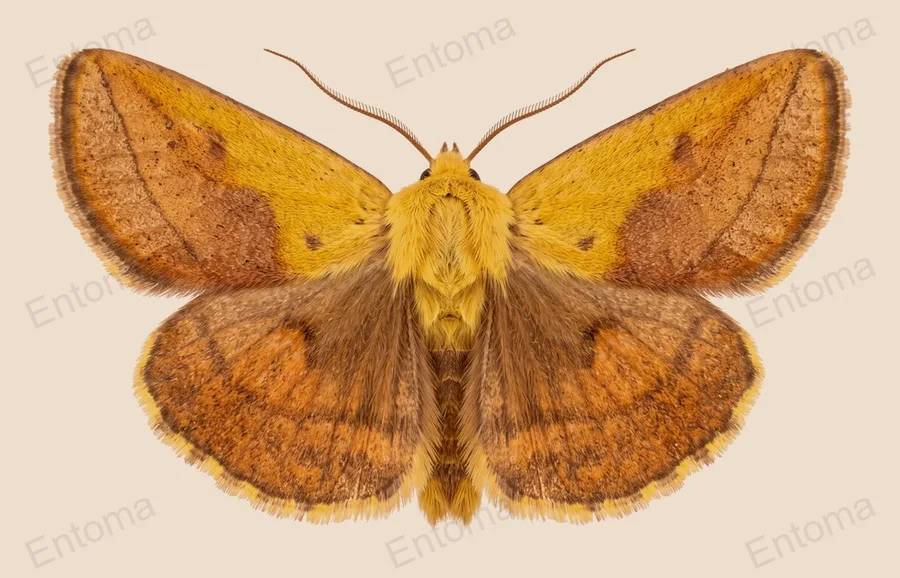
Monema flavescens
The larva of this slug moth is a green and yellow caterpillar about 18 to 24 mm long whose spines are a known skin irritant.
| Where | Broadleaf trees in orchards and parks |
|---|---|
| Size | 30 to 39 mm wingspan |
| When | April to October |
The adult is a small moth with a wingspan of about 30 to 39 mm, females larger than males. The thorax and inner forewings are light yellow and the rest of the wings are light reddish brown. The caterpillar is the form most people meet, a green and yellow, flattened slug shaped larva with blue, green and purple markings and spiny horns.
Depending on the climate there are one or two generations a year. The full grown larva spins a hard, oval cocoon on a branch, sometimes on the trunk, and spends the winter inside it as a mature larva.
Larvae eat the leaves of many broadleaf trees, with 51 plant species from 24 families on record, including zelkova, persimmon and cherry. It is regarded as a pest of broadleaf trees, including fruit and nut trees, and its relatives are leaf eating pests of cherry and persimmon trees from early summer to autumn.
Traits
Habitat
Garden
Colour
Yellow, Brown
Active
Night
To people
Take care
Do not touch the caterpillar with bare hands. Its spines are a known human irritant, and contact causes a strong, painful skin reaction that usually passes within a few days.
Activity through the year
Often confused with
As a caterpillar it is yellow green with a blue line along the back and red tipped spines, where this species is green and yellow with blue, green and purple markings.
Questions
Is Monema flavescens dangerous to people?
Take care. Do not touch the caterpillar with bare hands. Its spines are a known human irritant, and contact causes a strong, painful skin reaction that usually passes within a few days.
When can you see Monema flavescens?
Monema flavescens can be seen from April to October, at night.
Sources pmc.ncbi.nlm.nih.goveppo.inten.wikipedia.orgcity.saitama.lg.jp
Plate retouched from a photo by Jack Forrester, CC BY 4.0, iNaturalist Licence
Report a mistake in this entry
Butterflies and moths›Limacodidae›Monema
Last updated 2026-10-17. Every entry is checked against published sources.