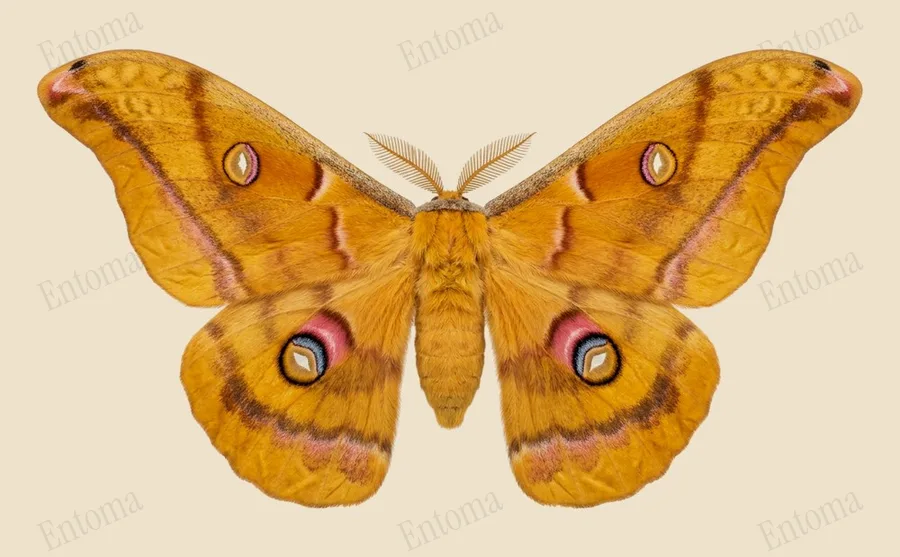
Japanese silk moth
This large silk moth's cocoon yields a rare green silk that Japanese weavers have prized for over a thousand years.
| Where | Deciduous oak forests across Japan |
|---|---|
| Size | 100 to 150 mm wingspan |
| When | July to October |
Adults are large moths with olive to yellow-green wings, each marked with a translucent eyespot on the fore and hind wing. The body is stout and covered in fine hair, and males carry broad, feathery antennae used to track female scent.
Caterpillars feed mainly on oak leaves in broadleaf forest and satoyama woodland, and the tough cocoon they spin has been harvested in Japan for tensan silk for over a thousand years. Adults do not feed and live only long enough to mate and lay eggs.
Traits
Habitat
Woodland
Colour
Yellow, Green
Active
Night
To people
Harmless to handle; farmed for its silk rather than avoided.
Activity through the year
Often confused with
Antheraea pernyi usually shows warmer red-brown wings with a pale-edged dark line, while Antheraea yamamai is olive-green to tan with a solid, unedged line.
Questions
Is the Japanese silk moth dangerous to people?
Harmless to handle; farmed for its silk rather than avoided.
When can you see the Japanese silk moth?
The Japanese silk moth can be seen from July to October, at night.
Plate retouched from a museum specimen photo by Swiss Natural History Collections - SwissNatColl, CC BY 4.0, GBIF Licence
Report a mistake in this entry
Butterflies and moths›Emperor moths›Antheraea
Last updated 2026-09-27. Every entry is checked against published sources.