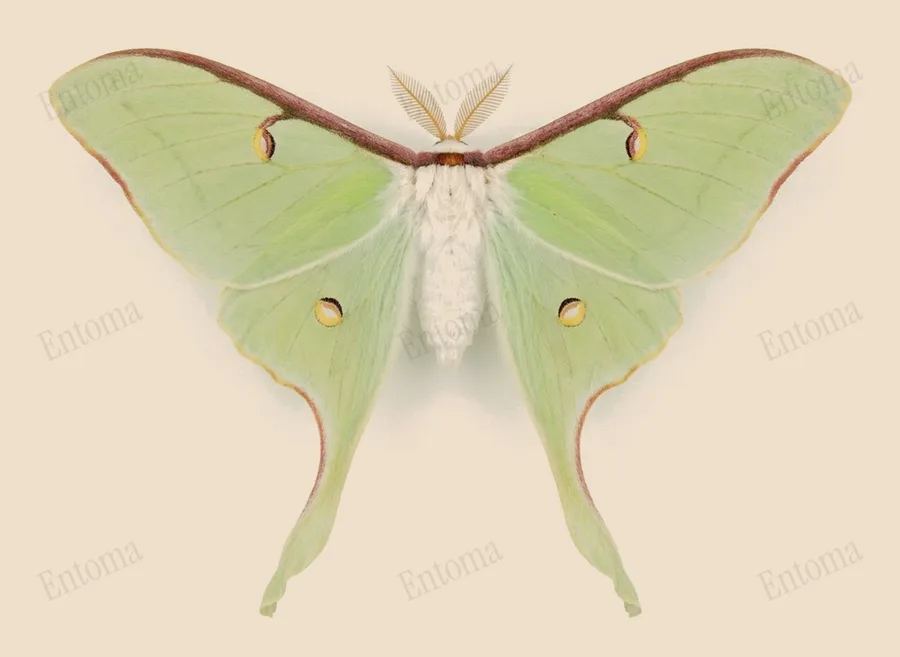
Ōmizuao
This moth's dark brown forewings are speckled with silvery blue scales, and its hindwings flash a bright blue patch only when it takes flight.
| Where | Deciduous forests, lowlands to mountains |
|---|---|
| Size | 80 to 120 mm wingspan |
| When | April to September |
Wings are translucent bluish green with a faint yellow or pinkish margin on the forewing, and each wing carries a rounded, near circular eyespot. Long ribbon-like tails trail from the hindwings, and males have broad, feathery antennae for detecting females.
Caterpillars feed on the leaves of broadleaf trees in the rose, beech, oak, birch and dogwood families, and adults do not feed at all. The species is single brooded in cooler areas but can produce two generations where summers are warmer.
Traits
Habitat
Woodland
Colour
Blue, Green
Active
Night
To people
Harmless to people; adults have no biting or stinging parts and do not feed at all once they emerge.
Activity through the year
Often confused with
Has sharper, pointed forewing tips and teardrop-shaped eyespots that bulge downward, rather than the rounded wingtips and near circular eyespots of Ōmizuao.
Questions
Is the Ōmizuao dangerous to people?
Harmless to people; adults have no biting or stinging parts and do not feed at all once they emerge.
When can you see the Ōmizuao?
The Ōmizuao can be seen from April to September, at night.
Plate retouched from a photo by りなべる, CC BY 4.0, iNaturalist Licence
Report a mistake in this entry
Butterflies and moths›Emperor moths›Actias
Last updated 2026-09-27. Every entry is checked against published sources.