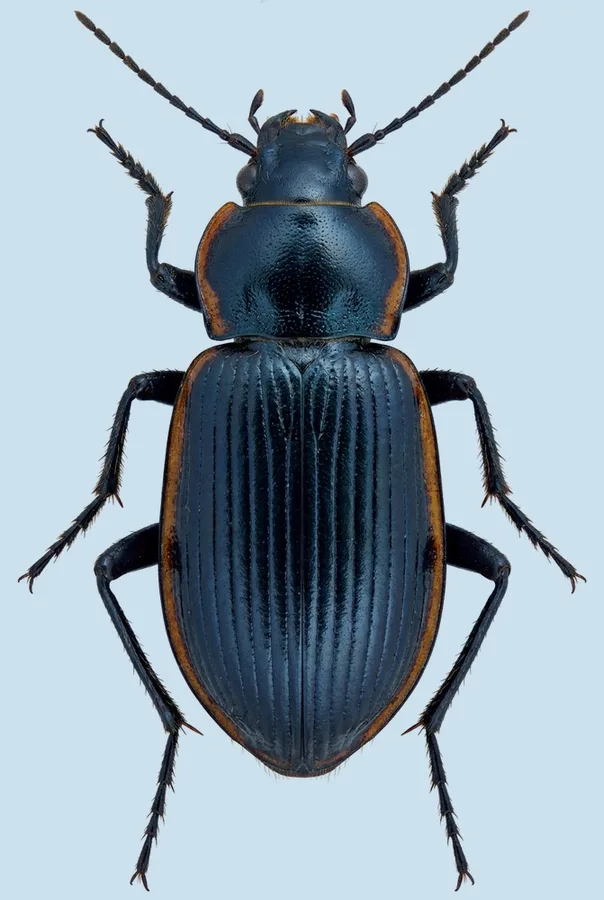
Plesiophthalmus nigrocyaneus
This beetle's body color ranges from black to deep metallic blue or greenish bronze depending on the population, all within one widespread species.
| Where | Broadleaf forests and forest edges |
|---|---|
| Size | 16 to 25 mm body length |
| When | May to September |
This darkling beetle has a rounded body and unusually long legs, with color that varies regionally from black to deep blue or greenish bronze. It moves quickly over standing tree trunks and fallen logs, which has earned it a Japanese name meaning tree circler.
Both larvae and adults feed on decaying wood and the fungi growing in it, living in broadleaf forests and forest edges from Hokkaido to Kyushu. It is often found where dead wood is left undisturbed close to human settlements.
Traits
Habitat
Woodland
Colour
Black, Blue, Metallic
Active
Day
To people
Not known to bite or sting; it simply feeds on rotting wood and is harmless to handle.
Activity through the year
Often confused with
A fast-moving, slender predatory ground beetle with thread-like antennae that hunts on the forest floor, unlike the slower, round-bodied beetle that walks over standing tree trunks and dead wood.
Questions
Is Plesiophthalmus nigrocyaneus dangerous to people?
Not known to bite or sting; it simply feeds on rotting wood and is harmless to handle.
When can you see Plesiophthalmus nigrocyaneus?
Plesiophthalmus nigrocyaneus can be seen from May to September, by day.
Plate retouched from a museum specimen photo by National Museum of Nature and Science, Japan, CC BY 4.0, GBIF Licence
Report a mistake in this entry
Beetles›Darkling beetles›Plesiophthalmus
Last updated 2026-09-27. Every entry is checked against published sources.