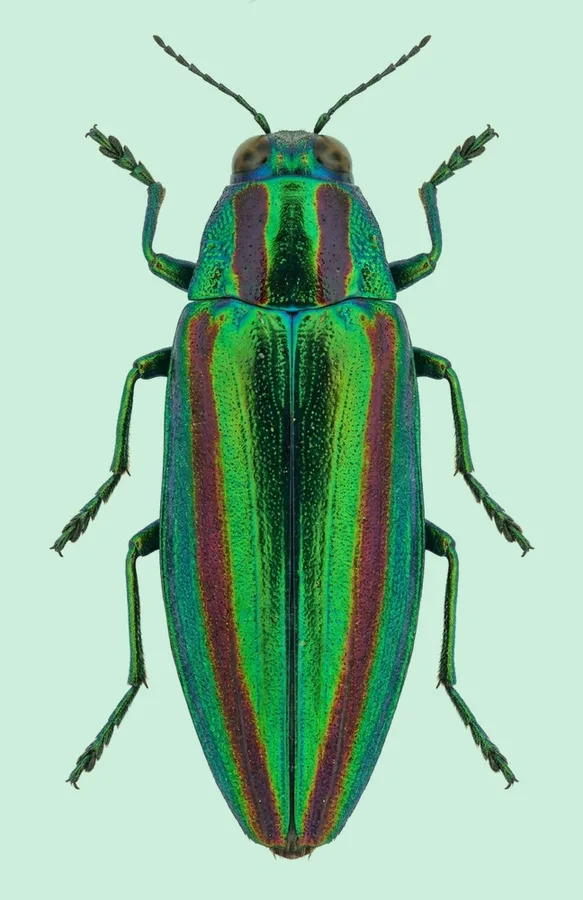
Japanese jewel beetle
For centuries craftsmen have used this beetle's colour-shifting wing cases to decorate shrines, including a famous seventh-century miniature shrine at a Nara temple.
| Where | Broadleaf forests across East Asia |
|---|---|
| Size | 30 to 41 mm body length |
| When | June to September |
The body has an overall metallic green luster crossed by rainbow-like red and green longitudinal stripes, with copper-purple bands between the wing case ridges. The related Chalcophora japonica is similarly large but shows brown and black stripes with gold flecks rather than this species' green and red iridescence.
Adults are drawn to strong sunshine and gather at freshly cut wood, basking on dry branches and bamboo, while larvae bore into the dead or damaged wood of broadleaf trees such as Japanese zelkova and hackberry.
Traits
Habitat
Woodland
Colour
Green, Red, Metallic
Active
Day
To people
Harmless to people; adults are strongly wary and quick to fly off if approached.
Activity through the year
Often confused with
Shows brown and black stripes with gold flecks, rather than the green metallic luster with red stripes and copper-purple bands seen in the Japanese jewel beetle.
Questions
Is the Japanese jewel beetle dangerous to people?
Harmless to people; adults are strongly wary and quick to fly off if approached.
When can you see the Japanese jewel beetle?
The Japanese jewel beetle can be seen from June to September, by day.
Plate retouched from a photo by WATANABE Hitoshi 渡辺仁, CC BY 4.0, iNaturalist Licence
Report a mistake in this entry
Beetles›Jewel beetles›Chrysochroa
Last updated 2026-09-27. Every entry is checked against published sources.