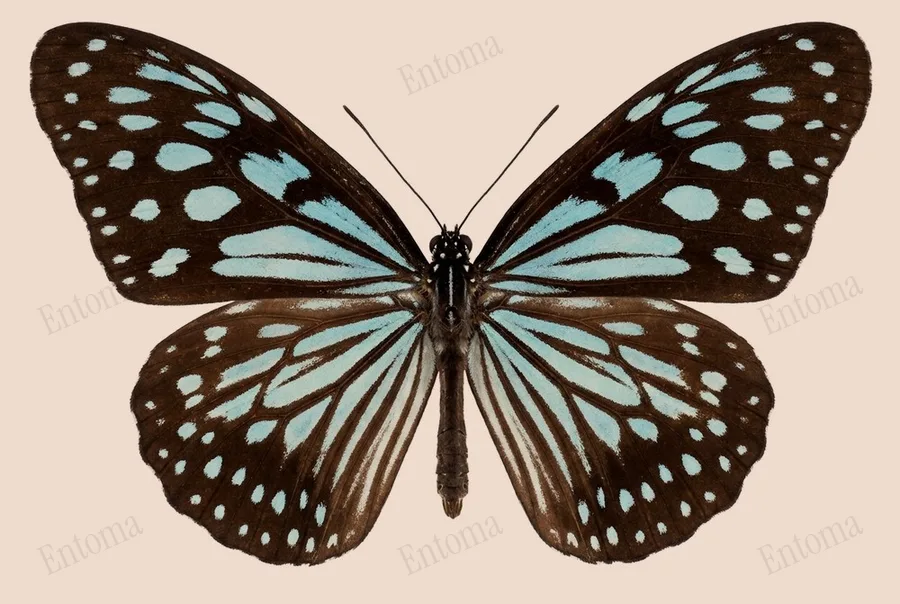
Ceylon blue glassy tiger
Caterpillars of this butterfly store toxic compounds from their host vine, which make the adults distasteful and give the wings their glassy, see-through patches.
| Where | Forests, gardens and coastal areas |
|---|---|
| Size | 60 to 80 mm wingspan |
| When | January to November |
The Ceylon blue glassy tiger has translucent, glass-like wings marked with pale blue and white spots on a blackish brown background, and a black body dotted with small white spots.
Caterpillars feed on Tylophora vines and store the plant's toxic compounds in their tissues, making the adults distasteful to birds; adults fly slowly through forests, gardens and coastal areas.
Traits
Habitat
Woodland
Colour
Blue, Black, White
Active
Day
To people
Mild
Distasteful to predators after storing plant toxins as a caterpillar; safe to touch.
Activity through the year
Often confused with
Similar blue and white glassy pattern, but has a solid transverse black bar across the forewing cell that the Ceylon blue glassy tiger lacks.
Questions
Is the Ceylon blue glassy tiger dangerous to people?
Mild. Distasteful to predators after storing plant toxins as a caterpillar; safe to touch.
When can you see the Ceylon blue glassy tiger?
The Ceylon blue glassy tiger can be seen from January to November, by day.
Plate retouched from a museum specimen photo by Lee Kong Chian Natural History Museum, National University of Singapore, CC BY 4.0, GBIF Licence
Report a mistake in this entry
Butterflies and moths›Brush-footed butterflies›Ideopsis
Last updated 2026-09-27. Every entry is checked against published sources.