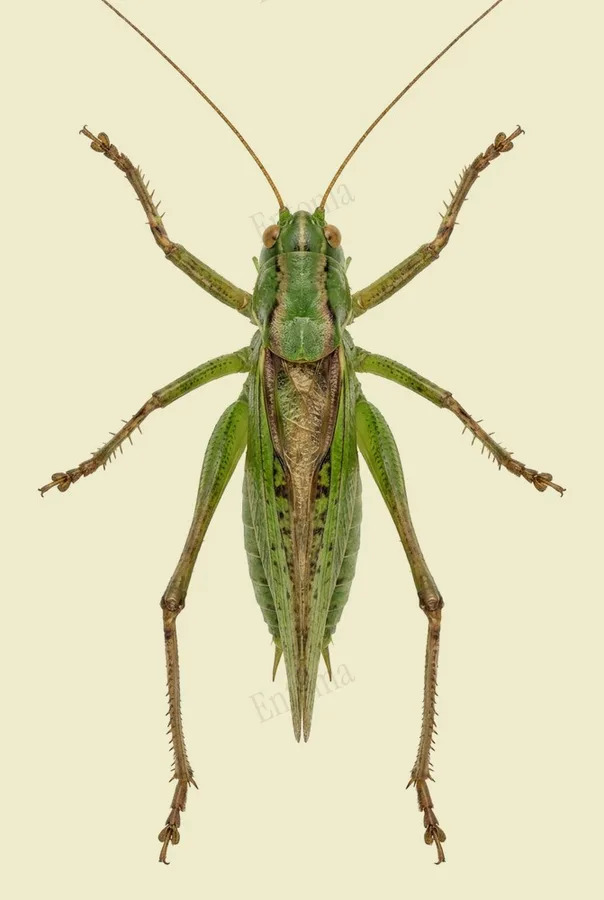
Gampsocleis buergeri
Long treated as one species, Japan's common katydid is now split in two, told apart by wing length and forewing spot pattern.
| Where | Sunny grasslands in western and southern Japan |
|---|---|
| Size | 29 to 39.5 mm body length |
| When | April to September |
Gampsocleis buergeri grows to about 29 to 39.5 mm from the head to the wingtips, and individuals occur in both green and brown colour forms within the same population. Its wings are relatively short, and any black spots along the forewing usually run in a single row, unlike the more numerous spots and shorter wings of its close relative Gampsocleis mikado.
Eggs spend the winter buried in the soil, and hatching nymphs need animal protein to grow properly, so besides grass seeds and leaves they hunt smaller insects and even each other as they mature. Males call mainly during hot, sunny weather, producing a sharp, two part rasping song from a small file on the forewing.
Traits
Habitat
Grassland
Colour
Green, Brown
Active
Day and night
To people
Mild
Bites in self defence if handled roughly, sometimes drawing a little blood, though it carries no venom.
Activity through the year
Often confused with
Its wings are shorter and carry more numerous black spots arranged in several rows, while Gampsocleis buergeri has longer wings with spots reduced to one row or none.
Distinctly larger at 45 to 58 mm to the wingtip, with more heavily spined legs, compared with the smaller, less heavily armed Gampsocleis buergeri.
Questions
Is Gampsocleis buergeri dangerous to people?
Mild. Bites in self defence if handled roughly, sometimes drawing a little blood, though it carries no venom.
When can you see Gampsocleis buergeri?
Gampsocleis buergeri can be seen from April to September, by day and at night.
Plate retouched from a photo by Saskia, CC BY 4.0, iNaturalist Licence
Report a mistake in this entry
Crickets and grasshoppers›Bush crickets›Gampsocleis
Last updated 2026-09-27. Every entry is checked against published sources.