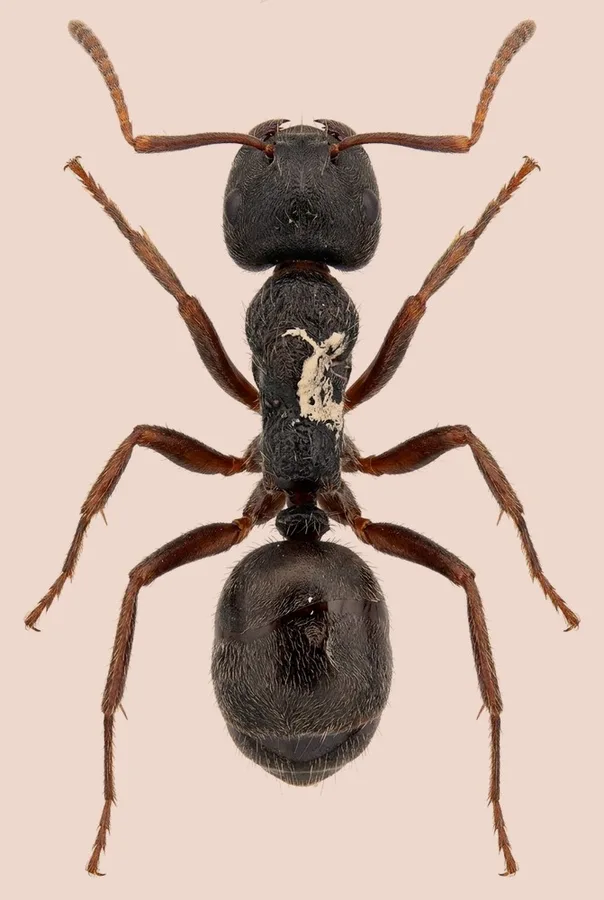
Cocoa black ant
Cocoa growers in Southeast Asia have long used this stingless ant as a living pest control, since it drives away the bugs that damage cocoa pods.
| Where | Forests, farmland and cocoa plantations |
|---|---|
| Size | 3 to 3.5 mm body length |
| When | January to December |
Workers are small, shiny and uniformly black to blackish brown, measuring 3 to 3.5 mm long, with a distinct deep groove across the top of the mesosoma that separates the middle body from the propodeum. Colonies build carton or leaf nests above ground in trees and shrubs, and workers travel in long, steady columns along branches and trunks.
Each colony can hold several egg laying queens and grow to tens of thousands of workers, and in return for protection the ants harvest sugary honeydew from scale insects and mealybugs they tend on host plants. Where nests are close to houses, their large columns and mass foraging can become a persistent household nuisance.
Traits
Habitat
Woodland
Colour
Black, Brown
Active
Day
To people
Has no sting and is not aggressive toward people; when disturbed it releases a characteristic odour from its glands rather than biting.
Activity through the year
Often confused with
Very similar in size and shiny black colour, but lacks the deep, broad groove across the mesosoma and the erect hairs found on the cocoa black ant.
Questions
Is the Cocoa black ant dangerous to people?
Has no sting and is not aggressive toward people; when disturbed it releases a characteristic odour from its glands rather than biting.
When can you see the Cocoa black ant?
The Cocoa black ant can be seen from January to December, by day.
Plate retouched from a museum specimen photo by Will Ericson, California Academy of Sciences, CC BY 4.0, GBIF Licence
Report a mistake in this entry
Bees, wasps and ants›Ants›Dolichoderus
Last updated 2026-09-27. Every entry is checked against published sources.