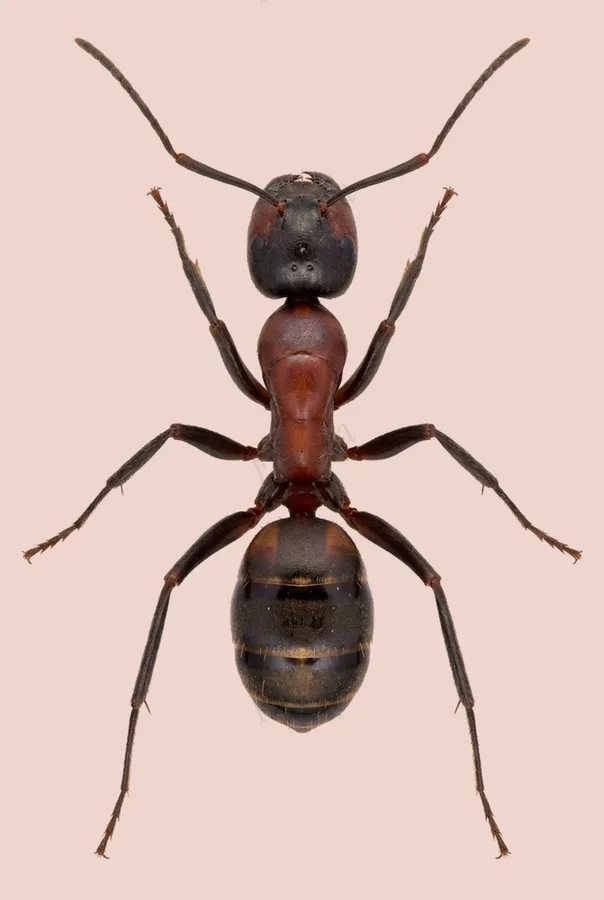
Camponotus obscuripes
Despite its size and painful bite, this ant has no sting at all, defending itself only with strong jaws and a spray of irritating formic acid.
| Where | Mountain forests with dead wood |
|---|---|
| Size | 8 to 12 mm body length |
| When | April to October |
This large ant is easy to recognise by its bright red thorax set against a black head and gaster, a pattern that separates it from the all black carpenter ants it is sometimes found alongside.
Workers forage alone rather than in trails, searching mountain forest and woodland for insect prey, sap and food scraps, and nest inside rotting logs and stumps. A colony is founded by a single queen and can grow to several hundred workers.
Traits
Habitat
Woodland
Colour
Red, Black
Active
Day
To people
Take care
Large mandibles give a painful bite if handled, and it can spray irritating formic acid; it has no sting.
Activity through the year
Often confused with
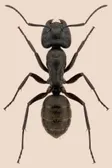
Entirely black to sooty grey over its whole body, without the bright red thorax that marks this species, though the two are similar in size and shape.
Questions
Is Camponotus obscuripes dangerous to people?
Take care. Large mandibles give a painful bite if handled, and it can spray irritating formic acid; it has no sting.
When can you see Camponotus obscuripes?
Camponotus obscuripes can be seen from April to October, by day.
Plate retouched from a photo by harum.koh, CC BY‑SA 4.0, iNaturalist Licence
The plate on this page is shared under the same licence as its source, CC BY-SA.
Report a mistake in this entry
Bees, wasps and ants›Ants›Camponotus
Last updated 2026-09-27. Every entry is checked against published sources.