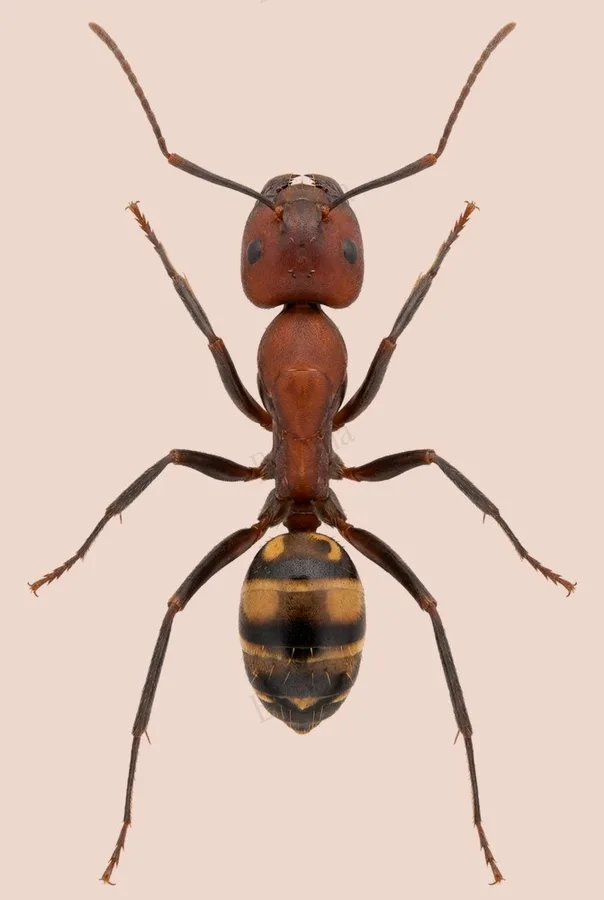
Camponotus habereri
This ant's Chinese name means stinky giant ant, earned from the sharp formic acid smell that workers spray when the nest is disturbed.
| Where | Tree trunks in forests and cities |
|---|---|
| Size | 7 to 12.5 mm body length |
| When | February to December |
Camponotus habereri is a large, polymorphic ant with a dark reddish head, mesosoma and petiole contrasting with a black gaster marked by pale tan patches. Minor workers measure 7 to 7.6 mm and major workers 12.1 to 12.5 mm, and majors carry noticeably large jaws used in nest defence.
Colonies nest inside tree trunks and dead wood in forests as well as street trees and urban green spaces, foraging mostly at night for nectar, insect honeydew and small dead insects, and defending the nest by biting and spraying formic acid.
Traits
Habitat
Woodland
Colour
Red, Black
Active
Night
To people
Mild
Large workers can give a sharp bite and spray formic acid if the nest is disturbed, though colonies are not reported to be aggressive.
Activity through the year
Often confused with
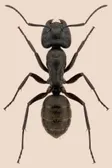
Similar in size, but uniformly black all over, without the contrasting dark reddish head and thorax that mark this species.
Questions
Is Camponotus habereri dangerous to people?
Mild. Large workers can give a sharp bite and spray formic acid if the nest is disturbed, though colonies are not reported to be aggressive.
When can you see Camponotus habereri?
Camponotus habereri can be seen from February to December, at night.
Plate retouched from a photo by Licheng Shih, CC BY 4.0, iNaturalist Licence
Report a mistake in this entry
Bees, wasps and ants›Ants›Camponotus
Last updated 2026-09-27. Every entry is checked against published sources.