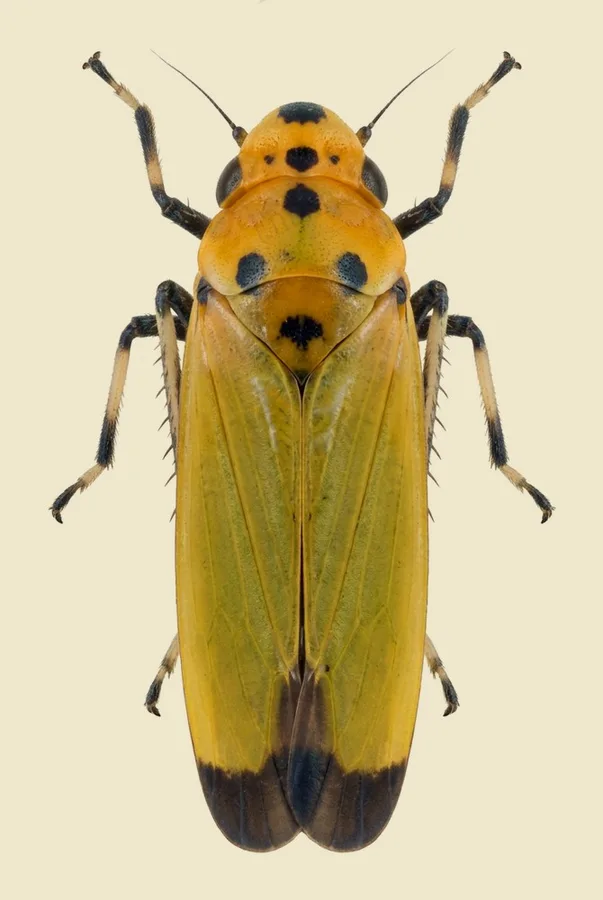
Black-tipped leafhopper
This yellow green leafhopper has a bold black band on each wingtip, and despite its bright colours it only sips plant sap and never bites people.
| Where | Forest and grassland edges, East Asia |
|---|---|
| Size | 13 to 14 mm body length |
| When | February and April to October |
The Black-tipped leafhopper has a bright yellow green body with a black oval mark on the head, three small black dots on the pronotum, and orange yellow wing cases crossed by a broad blue black band near the tip.
Adults and nymphs feed by sucking sap from a wide range of plants, including tea, mulberry, grape, citrus and soybean, overwintering as adults and staying active from late spring into autumn at forest and grassland edges.
Traits
Habitat
Woodland
Colour
Yellow, Green, Black
Active
Day
To people
Does not bite or sting people; feeds only on plant sap.
Activity through the year
Often confused with
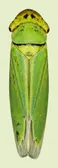
Smaller, about 8 to 10 mm long, pale green with only two small black dots on the head and faintly dusky wingtips, lacking the bold black wingtip band of the Black-tipped leafhopper.
Questions
Is the Black-tipped leafhopper dangerous to people?
Does not bite or sting people; feeds only on plant sap.
When can you see the Black-tipped leafhopper?
The Black-tipped leafhopper can be seen from February and April to October, by day.
Plate retouched from a photo by Céline, CC BY 4.0, iNaturalist Licence
Report a mistake in this entry
True bugs›Leafhoppers›Bothrogonia
Last updated 2026-09-27. Every entry is checked against published sources.