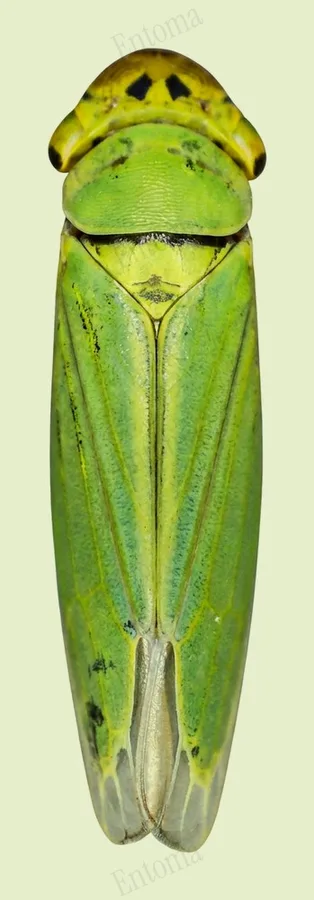
Green leafhopper
Males and females of this common leafhopper differ so much in color, dark blue purple against turquoise green, that they look like two different species.
| Where | Damp grassland, marshes and wet heath |
|---|---|
| Size | 6 to 9 mm body length |
| When | June to October |
This common leafhopper shows a pale yellow head with a pair of dark spots near the eyes and a green and yellow pronotum. Females have bright turquoise green forewings while males are dark blue to purple, a color difference striking enough that the two sexes look almost unrelated at first glance.
Nymphs and adults feed by piercing plant stems and sucking sap in damp, grassy or marshy ground, often in large numbers on rushes and sedges, with adults most numerous from summer into autumn.
Traits
Habitat
Wetland
Colour
Green, Blue, Yellow
Active
Day
To people
Feeds on plant sap and does not bite or sting people.
Activity through the year
Often confused with
A rarer, more slender relative found on sedges in wet peaty ground, lacking the blue or turquoise sheen and showing yellowish green forewings instead.
Questions
Is the Green leafhopper dangerous to people?
Feeds on plant sap and does not bite or sting people.
When can you see the Green leafhopper?
The Green leafhopper can be seen from June to October, by day.
Plate retouched from a museum specimen photo by Mikko Heikkinen, Finnish Biodiversity Information Facility, CC BY 4.0, GBIF Licence
Report a mistake in this entry
True bugs›Leafhoppers›Cicadella
Last updated 2026-09-26. Every entry is checked against published sources.