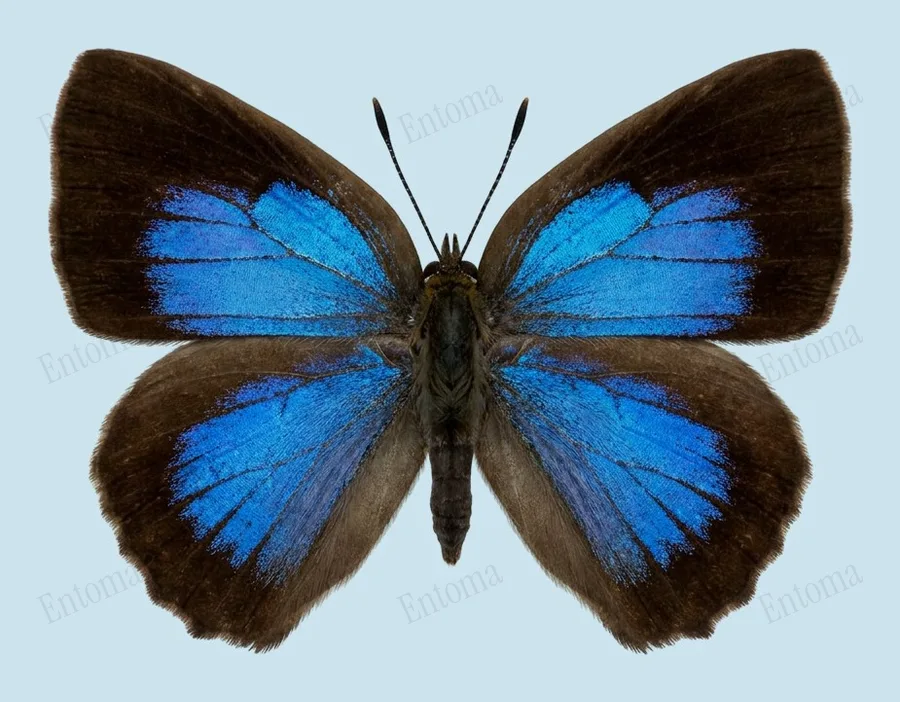
Japanese oakblue
Adults overwinter on evergreen oak leaves, and a few individuals can still be seen flying on mild winter days when most other butterflies have vanished.
| Where | Evergreen oak forests across East Asia |
|---|---|
| Size | 30 to 40 mm wingspan |
| When | March to November |
The Japanese oakblue has an iridescent blue purple upperside edged in black brown, while the underside is plain brown, a contrast that becomes obvious the moment it opens or closes its wings on a perch.
Caterpillars feed on the young leaves of evergreen oaks, building a shelter from folded leaves and secreting a sugary substance that attracts ants for protection. Adults overwinter and can be seen flying on mild days across much of the year rather than in one short season.
Traits
Habitat
Woodland
Colour
Blue, Brown
Active
Day
To people
A shade loving butterfly that rarely visits gardens; harmless to people.
Activity through the year
Often confused with
Has a pair of thin tail like projections on each hindwing that the Japanese oakblue completely lacks, and is slightly larger with a more rounded forewing tip.
Questions
Is the Japanese oakblue dangerous to people?
A shade loving butterfly that rarely visits gardens; harmless to people.
When can you see the Japanese oakblue?
The Japanese oakblue can be seen from March to November, by day.
Plate retouched from a museum specimen photo by Finnish Museum of Natural History - Zoology Unit, CC BY 4.0, GBIF Licence
Report a mistake in this entry
Butterflies and moths›Blues and coppers›Arhopala
Last updated 2026-09-27. Every entry is checked against published sources.