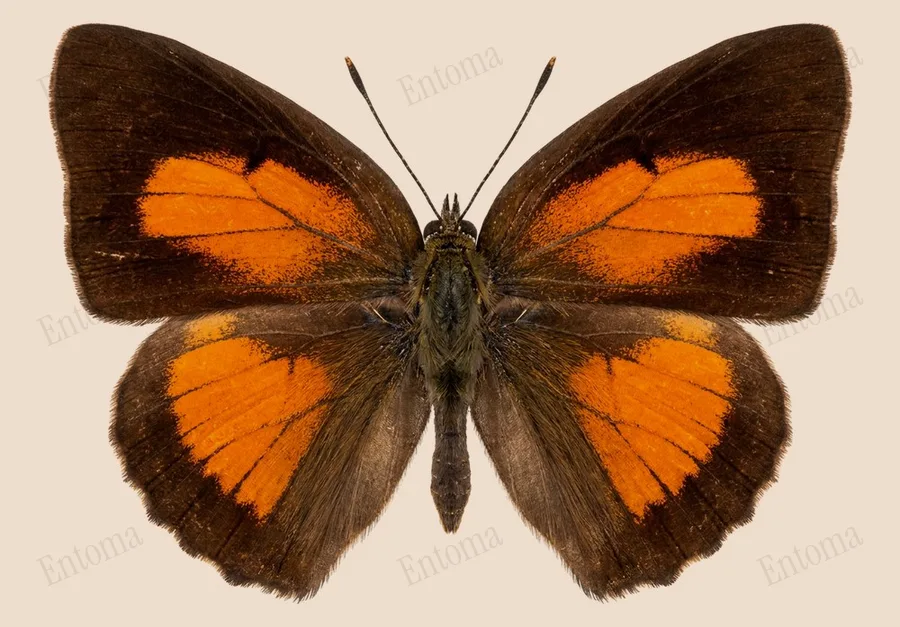
Angled sunbeam
Its silvery-white underside gives this butterfly its Japanese name, and with wings closed at rest it can look just like a curled dead leaf.
| Where | Forests and gardens across East Asia |
|---|---|
| Size | 30 to 40 mm wingspan |
| When | May to November |
Males show an orange-red flash on the upperside while females are largely white, but both sexes share a bright silver-white underside. The related Curetis brunnea is clearly larger and almost entirely brown, without the orange-red flash of this species.
Adults are unusual among the region's butterflies in overwintering as adults, so besides a main flight from early summer into autumn a few worn individuals can still be seen on mild days in early spring.
Traits
Habitat
Woodland
Colour
Orange, White
Active
Day
To people
Harmless to people; overwintering adults can sometimes be seen on warm winter days.
Activity through the year
Often confused with
Clearly larger at 46 to 48 mm and almost entirely brown, without the orange-red flash of the Angled sunbeam.
Questions
Is the Angled sunbeam dangerous to people?
Harmless to people; overwintering adults can sometimes be seen on warm winter days.
When can you see the Angled sunbeam?
The Angled sunbeam can be seen from May to November, by day.
Plate retouched from a museum specimen photo by Virginia Tech, Department of Entomology, Virginia Tech Insect Collection, CC0, GBIF Licence
Report a mistake in this entry
Butterflies and moths›Blues and coppers›Curetis
Last updated 2026-09-27. Every entry is checked against published sources.