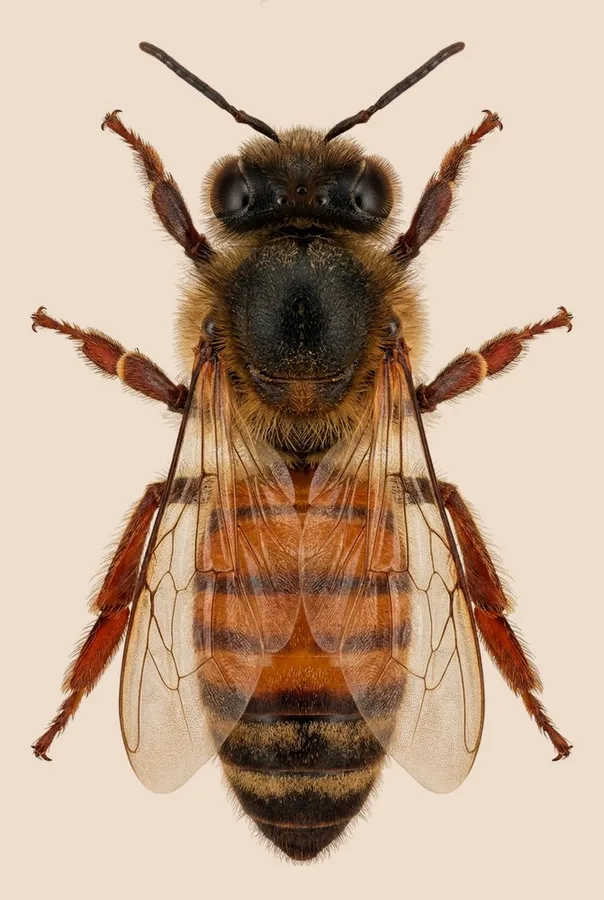
Asian honey bee
When a giant hornet approaches the hive, workers swarm around it and vibrate their flight muscles until the ball's core cooks the intruder alive.
| Where | Forests and farmland across East Asia |
|---|---|
| Size | 10 to 13 mm body length |
| When | March to November |
Workers are black with yellow bands across the abdomen and a covering of short, tawny hair, close in size to the familiar western honey bee. Colonies build multiple wax combs inside tree hollows or other sheltered cavities.
Rather than relying mainly on stings, colonies defend the nest against giant hornets by mobbing a scout and vibrating their flight muscles to heat the cluster past the point the hornet can survive. This behaviour is not seen in the western honey bee.
Traits
Habitat
Woodland
Colour
Black, Yellow
Active
Day
To people
Take care
Females can sting if the hive is disturbed, though this bee is generally calmer around people than the western honey bee.
Activity through the year
Often confused with
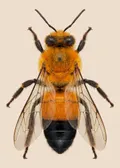
Apis dorsata is noticeably larger bodied and builds a single exposed comb hanging in the open on a cliff or tall tree, while Apis cerana is similar in size to the western honey bee and nests inside enclosed cavities.
Questions
Is the Asian honey bee dangerous to people?
Take care. Females can sting if the hive is disturbed, though this bee is generally calmer around people than the western honey bee.
When can you see the Asian honey bee?
The Asian honey bee can be seen from March to November, by day.
Plate retouched from a museum specimen photo by Harry Taylor NHM photo unit, Natural History Museum, CC0, GBIF Licence
Report a mistake in this entry
Bees, wasps and ants›Bees and bumblebees›Apis
Last updated 2026-09-27. Every entry is checked against published sources.