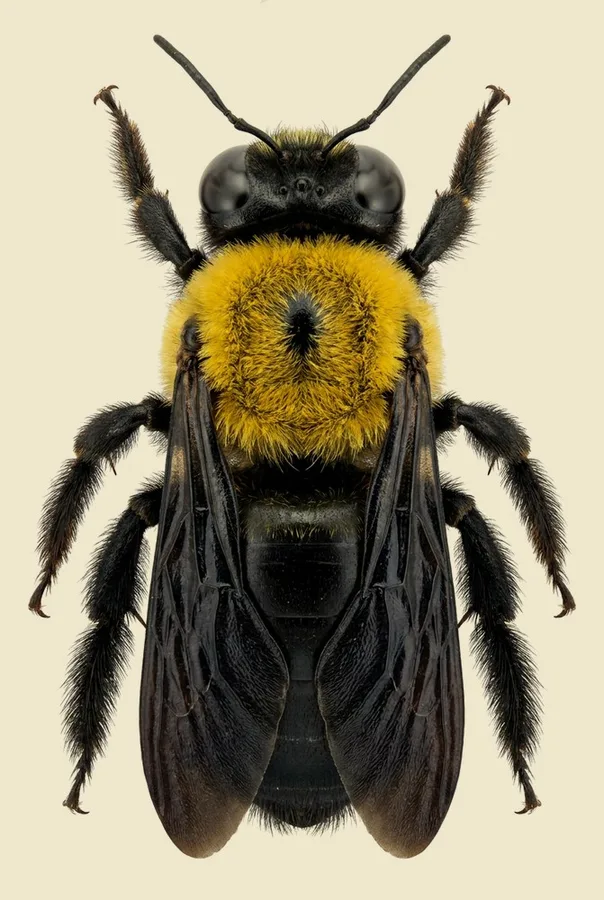
Appendiculate carpenter bee
Only females of this large bee carry a sting, and its venom has been found to contain peptides that are also under study as possible antimicrobial compounds.
| Where | Gardens and woodland edges across Japan |
|---|---|
| Size | 20 to 30 mm body length |
| When | April to October |
This large carpenter bee has a smooth, glossy black body with dense yellow or whitish hair on the thorax, contrasting with mostly black hair elsewhere; adults measure roughly 20 to 30 mm in length.
Females chew tunnels into dead wood to nest and provision their brood cells with pollen, while both sexes visit a wide range of garden and wild flowers; adults are active from spring into autumn across Japan, Korea and China.
Traits
Habitat
Garden
Colour
Black, Yellow
Active
Day
To people
Mild
Females can sting in self-defence, and the sting has been described as about as painful as a honeybee's; males cannot sting.
Activity through the year
Often confused with
A similarly large, dark bee found alongside it in Japan, Korea and China, but with a densely hairy body all over rather than the bald, shiny abdomen of the carpenter bee, and with orange-red hair at the tip of the abdomen.
Questions
Is the Appendiculate carpenter bee dangerous to people?
Mild. Females can sting in self-defence, and the sting has been described as about as painful as a honeybee's; males cannot sting.
When can you see the Appendiculate carpenter bee?
The Appendiculate carpenter bee can be seen from April to October, by day.
Plate retouched from a photo by Timur Kalininsky, CC BY 4.0, iNaturalist Licence
Report a mistake in this entry
Bees, wasps and ants›Bees and bumblebees›Xylocopa
Last updated 2026-09-27. Every entry is checked against published sources.