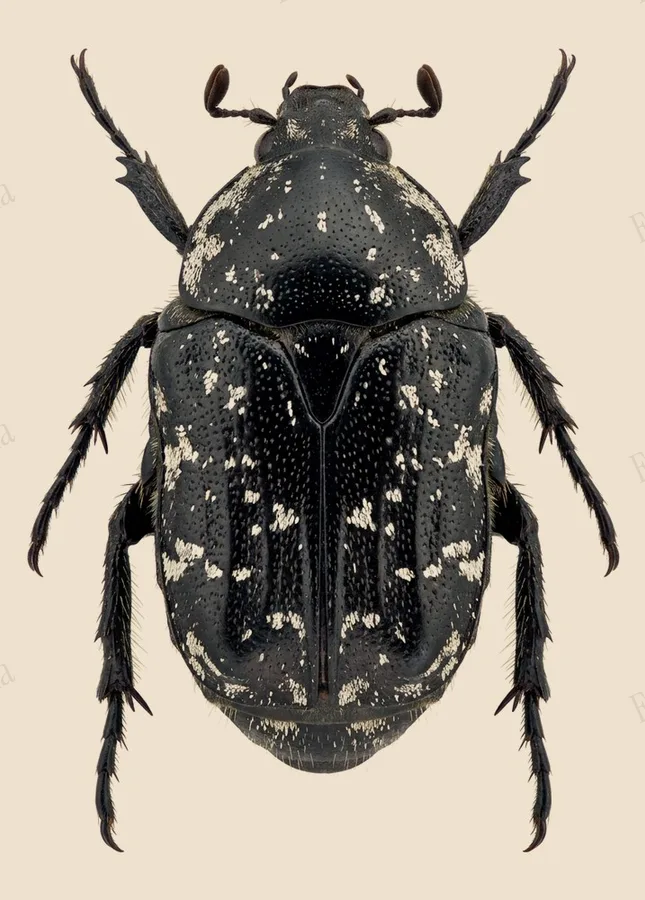
Valgus hemipterus
Females carry an unusually long, grooved tail-like extension for laying eggs deep inside rotting wood, a feature almost unheard of among scarab beetles.
| Where | Deciduous woodland with old wood |
|---|---|
| Size | 6 to 10 mm long |
| When | April to June |
It is a small, rugged-looking scarab covered in patches of pale, scale-like hairs over a black or dark brown body, with short elytra that leave part of the abdomen exposed and a finely toothed pronotum edge. Females carry a distinctive long, grooved extension at the tip of the abdomen that males lack.
Adults visit flowers such as cow parsley and scabious to feed on pollen, while the larvae develop inside rotting wood of deciduous trees and take part in breaking it down.
Traits
Habitat
Woodland
Colour
Black, Brown
Active
Day
To people
Harmless
Activity through the year
Often confused with
The bee beetle is larger at 9 to 12 mm and boldly banded in yellow-orange and black with dense yellow hair, unlike Valgus hemipterus's duller, patchier coat and shortened wing cases.
Questions
Is Valgus hemipterus dangerous to people?
Valgus hemipterus is harmless to people.
When can you see Valgus hemipterus?
Valgus hemipterus can be seen from April to June, by day.
Plate retouched from a photo by Francisco Welter-Schultes, CC0, Wikimedia Commons Licence
Report a mistake in this entry
Last updated 2026-09-26. Every entry is checked against published sources.