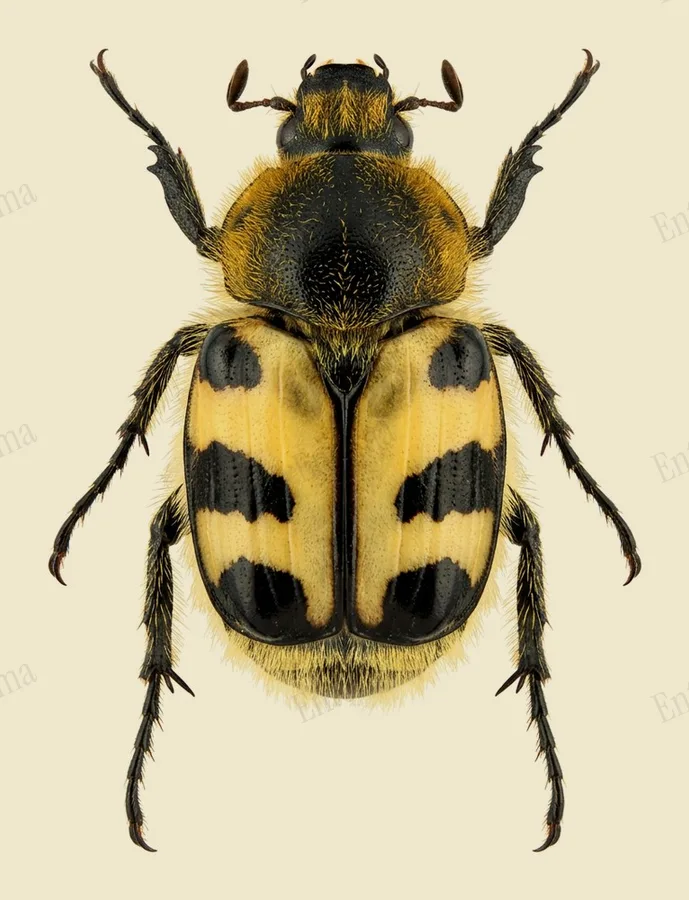
French flower chafer
This flower chafer's orange-red hairs and incomplete black bands help distinguish it from its close relative, the bee beetle, while both mimic bees on flowers.
| Where | Flowering meadows and grassland |
|---|---|
| Size | 10 to 12 mm body length |
| When | May to August |
The French flower chafer has a black head and pronotum, with yellowish wing cases crossed by a few incomplete black bands, and its body is covered in orange-red hairs that give it a bee-like appearance. The first black band on each wing case does not reach the scutellum, a useful identification feature.
Adults visit a wide range of flowers from late spring through summer, feeding on pollen and petals while mimicking the appearance of bees. Only males show a narrow band of white hairs near the tip of the abdomen.
Traits
Habitat
Grassland
Colour
Black, Yellow, Orange
Active
Day
To people
Visits garden and meadow flowers alongside bees; harmless to handle and does not sting.
Activity through the year
Often confused with
Similar in size at about 9 to 12 mm, but with white rather than orange-red hairs along the sides of the thorax and rear of the abdomen.
Questions
Is the French flower chafer dangerous to people?
Visits garden and meadow flowers alongside bees; harmless to handle and does not sting.
When can you see the French flower chafer?
The French flower chafer can be seen from May to August, by day.
Plate retouched from a photo by Rob Hille, CC BY‑SA 3.0, Wikimedia Commons Licence
The plate on this page is shared under the same licence as its source, CC BY-SA.
Report a mistake in this entry
Last updated 2026-09-26. Every entry is checked against published sources.