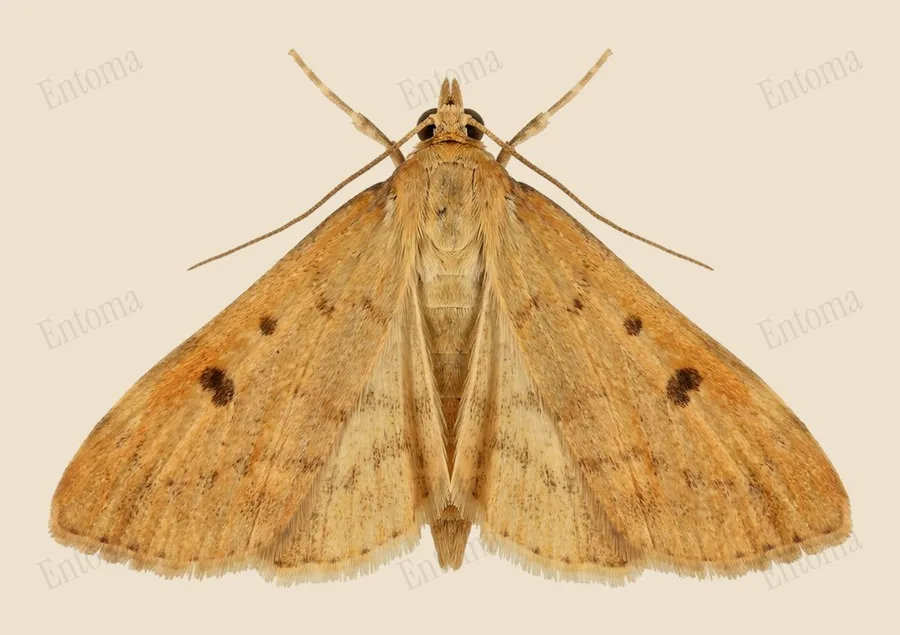
Rusty dot pearl
This small moth turns up almost anywhere in the world it can be blown to, since strong migratory flights carry it far beyond where its caterpillars can survive winter.
| Where | Gardens, coastal sites and farmland |
|---|---|
| Size | 18 to 22 mm wingspan |
| When | June to November |
The Rusty dot pearl has rusty orange forewings crossed by darker blackish markings and pale, whitish legs, a combination that separates it from other small grass moths sharing the same fields and gardens.
Adults are strong migrants and can appear at almost any time of year, with numbers building through several overlapping generations. Caterpillars feed on low herbaceous plants including dock, hemp-agrimony and wild strawberry, sheltering in a folded leaf by day.
Traits
Habitat
Garden
Colour
Orange, Brown
Active
Night
To people
Attracted to light; harmless to people.
Activity through the year
Often confused with
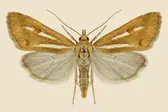
A similarly small grass moth at about 22 to 30 mm wingspan, but pale yellowish brown with a branching whitish streak rather than the Rusty dot pearl's solid rusty orange ground colour.
Questions
Is the Rusty dot pearl dangerous to people?
Attracted to light; harmless to people.
When can you see the Rusty dot pearl?
The Rusty dot pearl can be seen from June to November, at night.
Plate retouched from a photo by Ben Sale from Stevenage, UK, CC BY 2.0, Wikimedia Commons Licence
Report a mistake in this entry
Butterflies and moths›Grass moths›Udea
Last updated 2026-09-26. Every entry is checked against published sources.