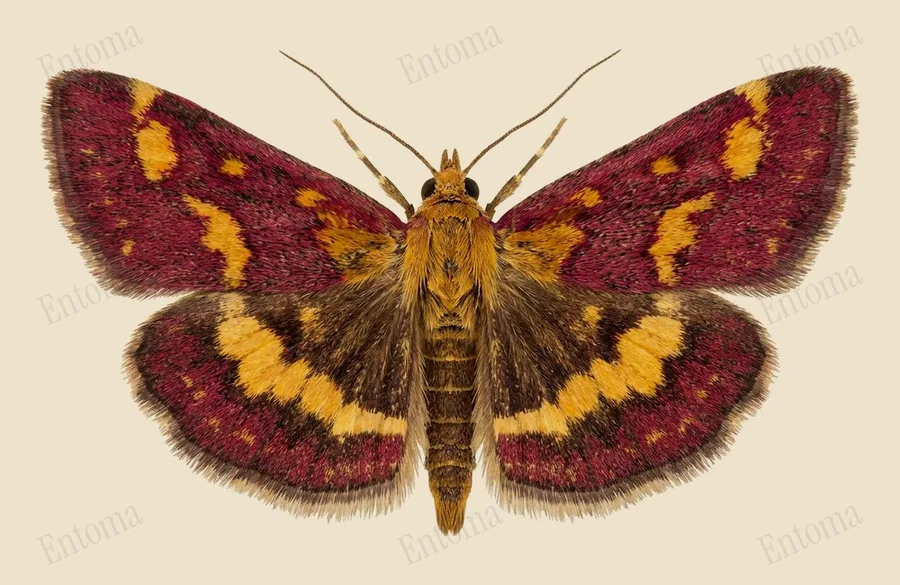
Common crimson-and-gold moth
The Common crimson-and-gold moth is one of the few day-flying moths of dry grassland, and its caterpillars feed inside leaves of thyme spun together with silk.
| Where | Dry grassland and chalky downland |
|---|---|
| Size | 15 to 22 mm wingspan |
| When | May to September |
The Common crimson-and-gold moth has purplish forewings mixed with dark grey and marked with black-edged ochreous yellow bands, and black hindwings with a pale central spot and curved band.
Caterpillars feed within spun leaves of thyme and sometimes corn mint, and the species is double brooded, flying by day and at night from May to September in dry grassland and chalky downland.
Traits
Habitat
Grassland
Colour
Black, Yellow
Active
Day and night
To people
Flies by day as well as at night; harmless to people.
Activity through the year
Often confused with
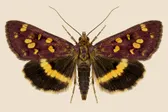
Slightly smaller at about 15 to 18 mm wingspan, with fewer cream markings on the forewing and a small or broken spot near the inner margin rather than the rounded cream spot of the Common crimson-and-gold moth.
Questions
Is the Common crimson-and-gold moth dangerous to people?
Flies by day as well as at night; harmless to people.
When can you see the Common crimson-and-gold moth?
The Common crimson-and-gold moth can be seen from May to September, by day and at night.
Plate retouched from a photo by Ben Sale from Stevenage, UK, CC BY 2.0, Wikimedia Commons Licence
Report a mistake in this entry
Butterflies and moths›Grass moths›Pyrausta
Last updated 2026-09-26. Every entry is checked against published sources.