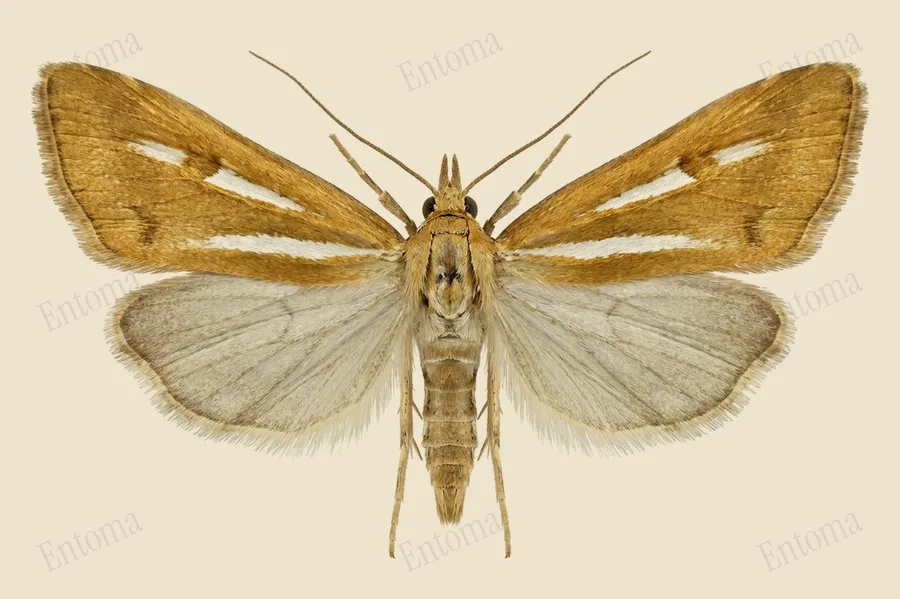
Common grass-veneer
At rest this grass moth folds its wings into a narrow tube shape along a plant stem, making it nearly invisible among dry grass stalks.
| Where | Grassy meadows, woodland rides and heaths |
|---|---|
| Size | 22 to 30 mm wingspan |
| When | July to September |
The Common grass-veneer has pale yellowish brown forewings crossed by a whitish streak that splits into several thin branches near the wing tip, a pattern typical of the grass moths in this group.
Caterpillars feed low down on grasses such as meadow-grass and hair-grass, and the single generation of adults flies through summer, resting head-down on grass stems by day and coming readily to light after dark.
Traits
Habitat
Grassland
Colour
Brown, Yellow
Active
Night
To people
Attracted to light; harmless to people.
Activity through the year
Often confused with
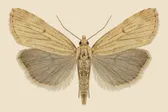
Noticeably smaller at 16 to 20 mm wingspan and plainer, pale straw colored, lacking the branching white streak that marks the Common grass-veneer.
Questions
Is the Common grass-veneer dangerous to people?
Attracted to light; harmless to people.
When can you see the Common grass-veneer?
The Common grass-veneer can be seen from July to September, at night.
Plate retouched from a photo by Pekka Malinen, Luomus, CC BY‑SA 4.0, Wikimedia Commons Licence
The plate on this page is shared under the same licence as its source, CC BY-SA.
Report a mistake in this entry
Butterflies and moths›Grass moths›Agriphila
Last updated 2026-09-26. Every entry is checked against published sources.