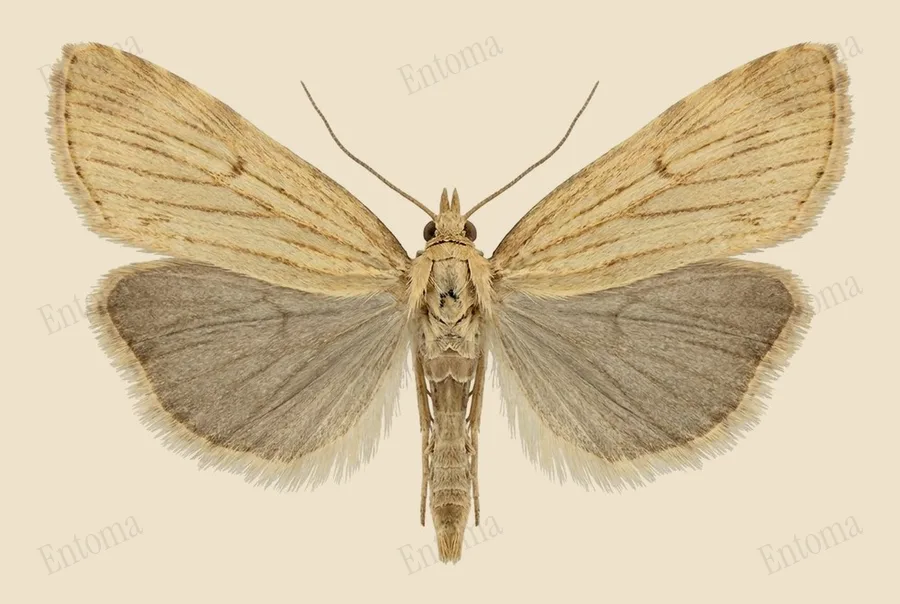
Pearl veneer
Its caterpillars feed unseen at the base of grass stems, and the plain, pale adult moth is easily one of the most overlooked insects in open grassland.
| Where | Grassy meadows, verges and dunes |
|---|---|
| Size | 16 to 20 mm wingspan |
| When | June to September |
The Pearl veneer has pale straw brown forewings crossed by a thin whitish streak that splits into fine branches near the tip, a scattering of black dots along the margin, and darker grey hindwings.
Its caterpillars feed low down at the base of fine grasses such as sheep's fescue, and the single generation of plain, pale adults is easily overlooked among dry grass stems through summer.
Traits
Habitat
Grassland
Colour
Brown, Yellow
Active
Night
To people
Comes readily to light after dark and is harmless, spending its short adult life quietly among grass stems.
Activity through the year
Often confused with
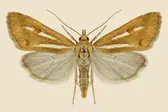
Noticeably larger with a wingspan of about 22 to 30 mm, and its pale streak fans into more distinct branching fingers near the tip than the shorter streak of the Pearl veneer.
Questions
Is the Pearl veneer dangerous to people?
Comes readily to light after dark and is harmless, spending its short adult life quietly among grass stems.
When can you see the Pearl veneer?
The Pearl veneer can be seen from June to September, at night.
Plate retouched from a museum specimen photo by Jan Erik Røer, Norwegian Biodiversity Information Centre, CC BY 4.0, GBIF Licence
Report a mistake in this entry
Butterflies and moths›Grass moths›Agriphila
Last updated 2026-09-26. Every entry is checked against published sources.