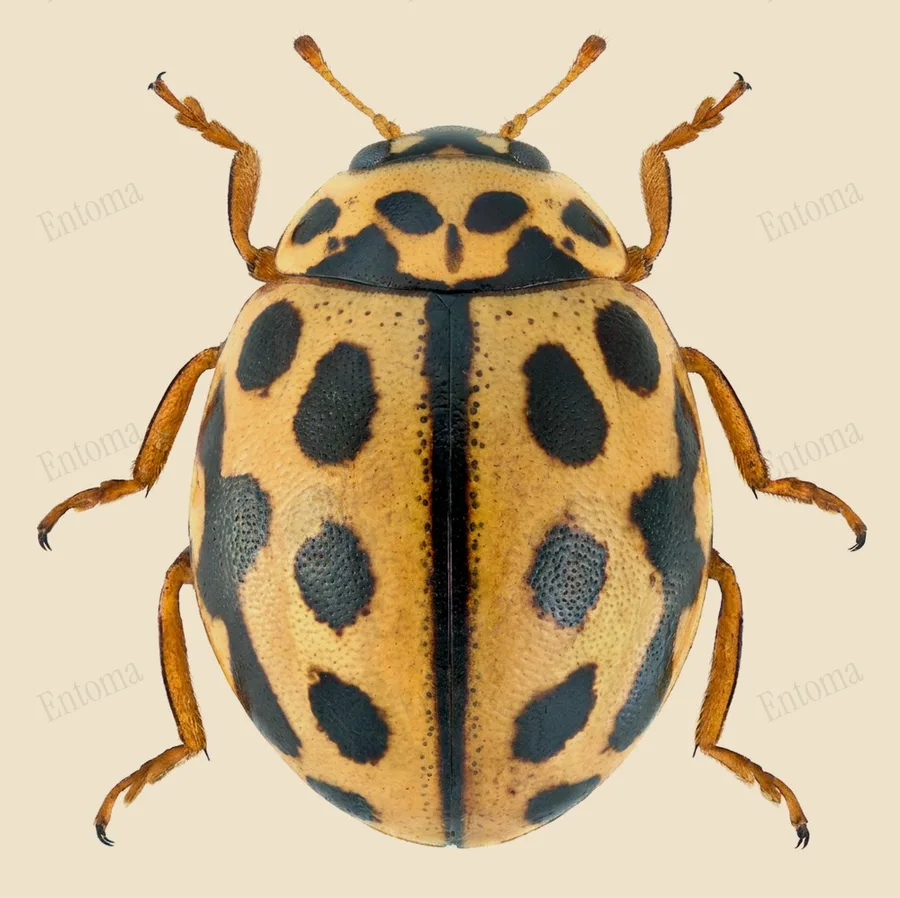
16-spot ladybird
Despite its name, individual 16-spot ladybirds can show anywhere from about 13 to 18 spots, with several often fused into a solid dark line.
| Where | Grassland and low vegetation |
|---|---|
| Size | 2 to 3 mm long |
| When | March to September |
It is a very small, pale beige to cream ladybird patterned with black spots, most distinctively a black line running down the centre of the wing cases. On each wing case the three outer spots are often fused into a single dark patch or streak.
Unlike most ladybirds it is not mainly predatory: adults and larvae feed largely on pollen, nectar and fungal spores, and large numbers often gather together in grass tussocks and leaf litter to overwinter.
Traits
Habitat
Grassland
Colour
White, Black
Active
Day
To people
Harmless
Activity through the year
Often confused with
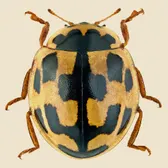
The 14-spot ladybird shares a dark central line but is larger at 3.5 to 4.5 mm and lemon-yellow to cream with black, often square spots, rather than the smaller 16-spot's beige tone.
Questions
Is the 16-spot ladybird dangerous to people?
The 16-spot ladybird is harmless to people.
When can you see the 16-spot ladybird?
The 16-spot ladybird can be seen from March to September, by day.
Plate retouched from a photo by Udo Schmidt from Deutschland, CC BY‑SA 2.0, Wikimedia Commons Licence
The plate on this page is shared under the same licence as its source, CC BY-SA.
Report a mistake in this entry
Last updated 2026-09-26. Every entry is checked against published sources.