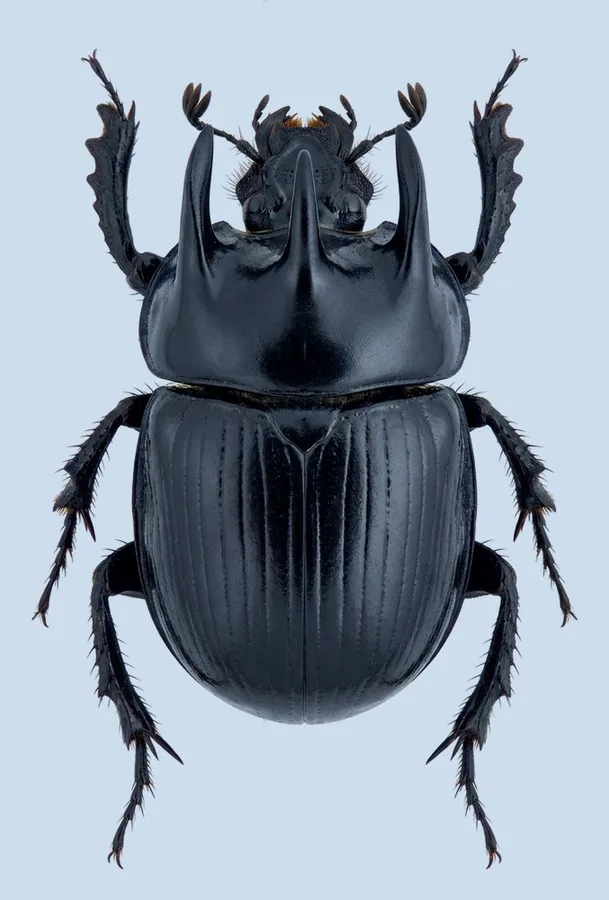
Minotaur beetle
Males of this dung beetle carry three forward-pointing horns used to wrestle rivals for burrows that can run more than a metre into sandy soil.
| Where | Sandy heath and grazed grassland |
|---|---|
| Size | 12 to 20 mm body length |
| When | January to June, September to November |
The minotaur beetle is a shining black dung beetle 12 to 20 mm long, immediately recognisable in males by three horn-like projections on the thorax, two long outer horns and one short one in the middle; females instead have only small pointed bumps.
It digs deep vertical burrows, sometimes more than a metre down with numerous side branches, provisioning them with rabbit, sheep or deer droppings on which the larvae feed. Adults are mostly nocturnal and are on the wing from January to June and from September to November.
Traits
Habitat
Heath
Colour
Black
Active
Night
To people
It does not bite or sting and is completely harmless to handle.
Activity through the year
Often confused with
Similar dark, rounded shape but up to 25 mm long and lacking horns altogether, often showing a metallic blue, green or violet sheen on its underside that the Minotaur beetle lacks.
Questions
Is the Minotaur beetle dangerous to people?
It does not bite or sting and is completely harmless to handle.
When can you see the Minotaur beetle?
The Minotaur beetle can be seen from January to June, September to November, at night.
Plate retouched from a photo by Ben Sale from Stevenage, UK, CC BY 2.0, Wikimedia Commons Licence
Report a mistake in this entry
Last updated 2026-09-26. Every entry is checked against published sources.