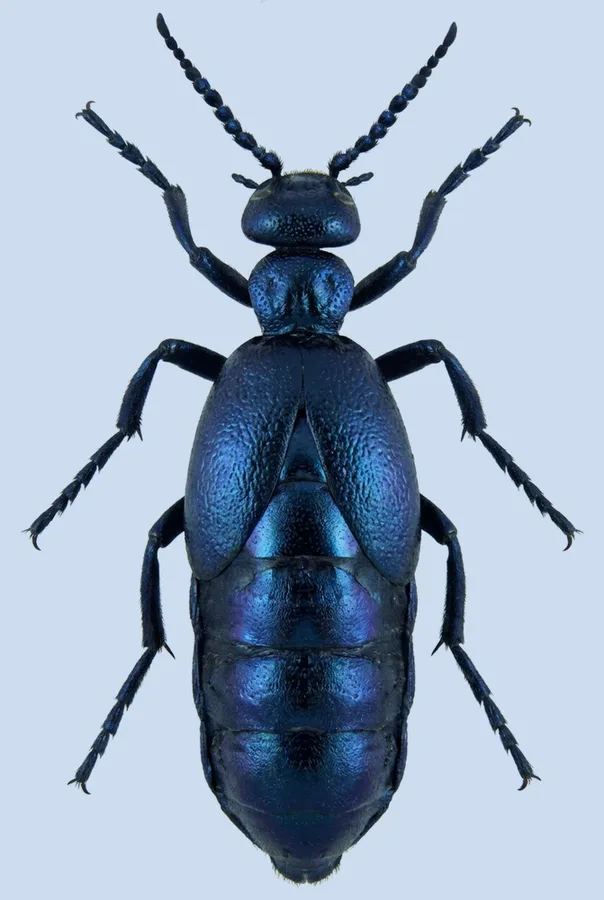
Black oil beetle
When disturbed, this beetle oozes bright orange blood from its leg joints containing cantharidin, a chemical strong enough to blister skin and potentially fatal if swallowed.
| Where | Flower-rich meadows and grassland edges |
|---|---|
| Size | 10 to 30 mm body length |
| When | February to May |
The Black oil beetle is a large, wingless beetle up to 30 mm long with a shiny black body, occasionally showing a faint blue-violet sheen, and a swollen, sac-like abdomen that is especially pronounced in egg-laden females.
Females lay very large numbers of eggs in soil burrows, and the tiny larvae climb onto flowers to hitch a ride on visiting solitary bees, completing their development inside the host bee's nest on stores of pollen and nectar.
Traits
Habitat
Grassland
Colour
Black
Active
Day
To people
Take care
Should not be handled bare-handed; its blood contains cantharidin, which can blister skin and is toxic if swallowed.
Activity through the year
Often confused with
Similar size at 10 to 30 mm and often confused since colour overlaps, but it usually shows a violet-blue sheen and an indented lower thorax edge that the Black oil beetle lacks.
Questions
Is the Black oil beetle dangerous to people?
Take care. Should not be handled bare-handed; its blood contains cantharidin, which can blister skin and is toxic if swallowed.
When can you see the Black oil beetle?
The Black oil beetle can be seen from February to May, by day.
Plate retouched from a photo by Udo Schmidt, CC BY‑SA 2.0, Wikimedia Commons Licence
The plate on this page is shared under the same licence as its source, CC BY-SA.
Report a mistake in this entry
Last updated 2026-09-26. Every entry is checked against published sources.