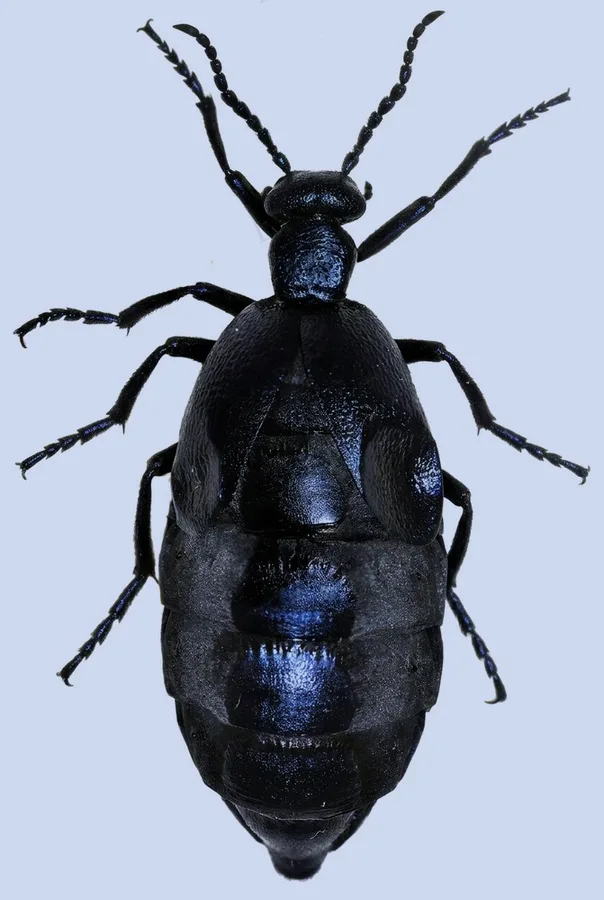
Violet oil beetle
When threatened, this flightless beetle oozes drops of orange blood containing cantharidin from its leg joints, a defence potent enough to blister human skin on contact.
| Where | Sunny grassland, heathland and woodland edges |
|---|---|
| Size | 10 to 30 mm body length |
| When | March to June |
The violet oil beetle is a heavy-bodied, flightless beetle 10 to 30 mm long, with short overlapping wing cases that leave much of the swollen abdomen exposed, especially in egg-laden females. Its body is glossy black with violet or blue reflections, and the rear edge of the thorax is indented with a small tooth behind it, a detail that separates it from the similar black oil beetle.
Adults crawl slowly over the ground from March to June, feeding on low vegetation in sunny grassland, heathland and woodland edges. If handled or crushed, they release an oily orange fluid containing cantharidin from their leg joints, which can blister skin and is dangerous if swallowed.
Traits
Habitat
Grassland
Colour
Black, Blue
Active
Day
To people
Take care
It does not bite or sting, but handling or crushing it releases a cantharidin-laced fluid that can blister skin, so it is best only watched, not picked up.
Activity through the year
Often confused with
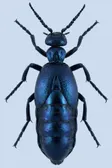
Very similar in size, up to about 30 mm, and sometimes just as violet-blue in colour, but told apart by the rear edge of the thorax, which is almost straight with only a small tooth, compared with the indented edge and larger tooth of the Violet oil beetle.
Questions
Is the Violet oil beetle dangerous to people?
Take care. It does not bite or sting, but handling or crushing it releases a cantharidin-laced fluid that can blister skin, so it is best only watched, not picked up.
When can you see the Violet oil beetle?
The Violet oil beetle can be seen from March to June, by day.
Plate retouched from a photo by Francisco Welter-Schultes, CC0, Wikimedia Commons Licence
Report a mistake in this entry
Last updated 2026-09-26. Every entry is checked against published sources.