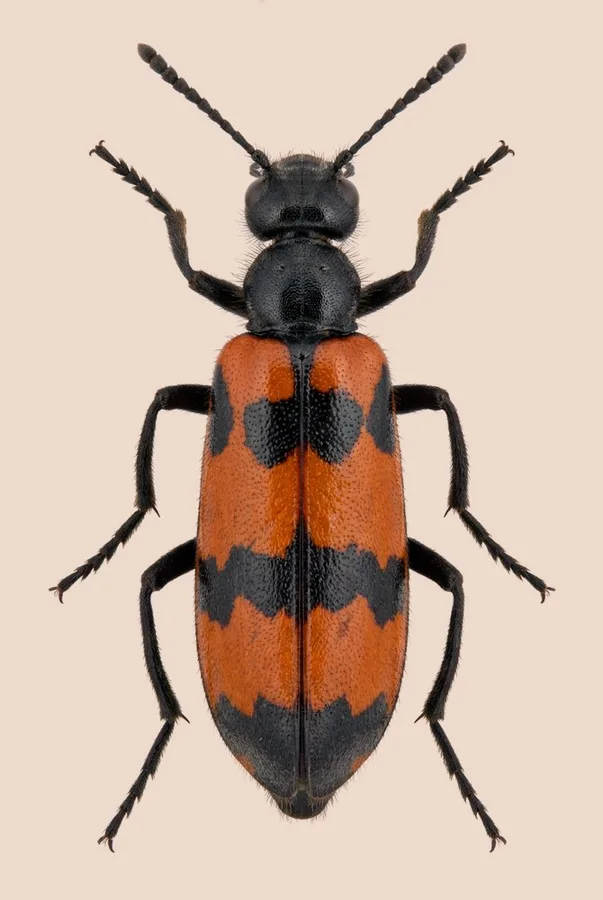
Mylabris variabilis
Its yellow-orange elytra carry three black wavy bands, and when disturbed it oozes cantharidin, a blistering compound also produced for medicinal extracts.
| Where | Dry meadows and grassland in warm regions |
|---|---|
| Size | 7 to 20 mm body length |
| When | May to August |
The body is cylindrical and covered in short hair, with a square black head and long black antennae. The wing covers are yellow to orange with three broad, irregular black bands that vary in width from one beetle to another.
Adults are most active in the hottest part of the day, flying between flowers on dry meadows to feed on pollen and nectar. If disturbed, they release droplets of cantharidin, an oily defensive compound, from their leg and antennal joints.
Traits
Habitat
Grassland
Colour
Black, Orange
Active
Day
To people
Take care
Should not be handled bare handed; its secretion contains cantharidin, which blisters skin on contact and is toxic if swallowed.
Activity through the year
Often confused with
Similar in size, about 13 to 16 mm, but recognized by four large black spots on orange to red wing covers rather than the three wavy bands of Mylabris variabilis.
Questions
Is Mylabris variabilis dangerous to people?
Take care. Should not be handled bare handed; its secretion contains cantharidin, which blisters skin on contact and is toxic if swallowed.
When can you see Mylabris variabilis?
Mylabris variabilis can be seen from May to August, by day.
Plate retouched from a photo by Hectonichus, CC BY‑SA 4.0, Wikimedia Commons Licence
The plate on this page is shared under the same licence as its source, CC BY-SA.
Report a mistake in this entry
Beetles›Blister beetles›Mylabris
Last updated 2026-09-26. Every entry is checked against published sources.