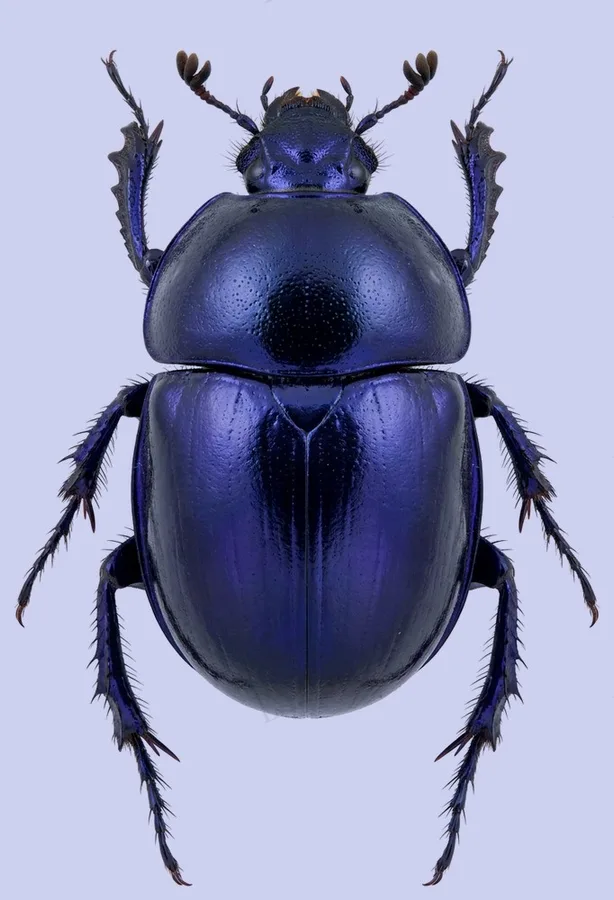
Springtime dung beetle
Despite the name, this beetle can turn up on dung from spring right through autumn, its black body gleaming with blue, green or pink.
| Where | Open grassland, moorland and young woodland |
|---|---|
| Size | 14 to 20 mm body length |
| When | April to October |
This dung beetle is a rounded, shiny black species with a variable metallic sheen of blue, green or pink. Its pronotum is noticeably punctured and its smooth wing covers lack ridges, features that separate it from the closely related heath dumbledor.
Adults and larvae feed on the dung of sheep, cattle, horses and foxes in open grassland and young woodland. The species is most numerous in spring and early summer and only rarely seen in autumn.
Traits
Habitat
Grassland
Colour
Black, Metallic
Active
Day and night
To people
Harmless to people; sometimes seen walking over dung in pastures and open grassland.
Activity through the year
Often confused with
Similar in size, 12 to 26 mm, but with a smooth, shiny pronotum bearing only a few tiny punctures, unlike the distinctly punctured pronotum of the springtime dung beetle.
Questions
Is the Springtime dung beetle dangerous to people?
Harmless to people; sometimes seen walking over dung in pastures and open grassland.
When can you see the Springtime dung beetle?
The Springtime dung beetle can be seen from April to October, by day and at night.
Plate retouched from a photo by Francisco Welter-Schultes, CC0, Wikimedia Commons Licence
Report a mistake in this entry
Beetles›Dor beetles›Trypocopris
Last updated 2026-09-26. Every entry is checked against published sources.