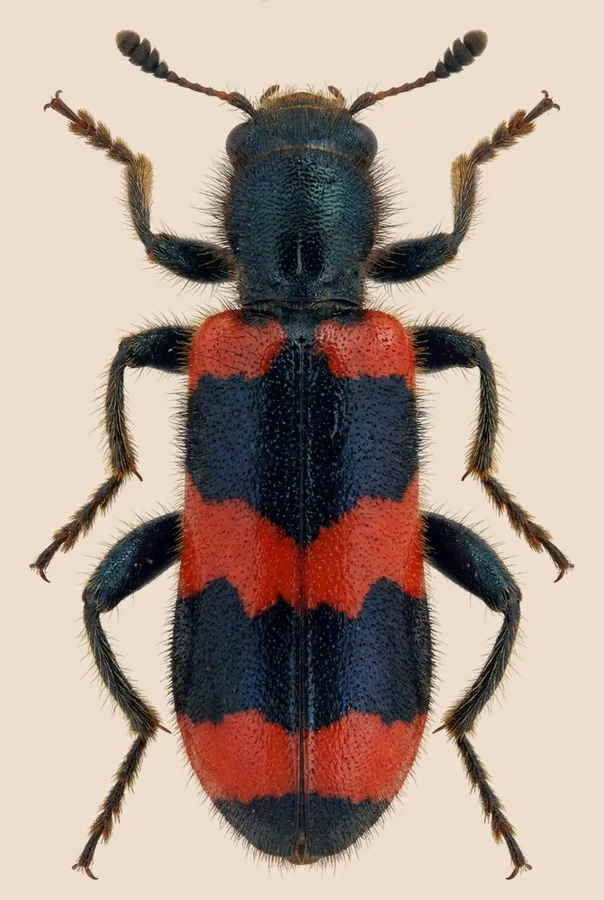
Bee-eating beetle
Its larvae hatch inside solitary bee nests and eat the eggs and grubs of their hosts before pupating in the very cells they emptied.
| Where | Flowery meadows, hedgerows and woodland edges |
|---|---|
| Size | 9 to 16 mm body length |
| When | May to August |
Adults are hairy beetles with bright red elytra crossed by broad black bands, a shining blue black head, and a red apex reaching close to the wing tips.
Adults visit flowers such as wild carrot and hogweed to feed on pollen through late spring and summer, while females lay eggs near the nests of solitary bees for their predatory larvae.
Traits
Habitat
Grassland
Colour
Red, Black
Active
Day
To people
Does not sting; adults are seen openly on flowers and pose no risk when handled.
Activity through the year
Often confused with
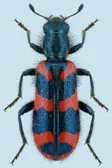
Similar in size at up to 17 mm, but its black terminal band does not reach the very end of the elytra, leaving a clear red apex unlike the Bee-eating beetle.
Questions
Is the Bee-eating beetle dangerous to people?
Does not sting; adults are seen openly on flowers and pose no risk when handled.
When can you see the Bee-eating beetle?
The Bee-eating beetle can be seen from May to August, by day.
Plate retouched from a photo by Francisco Welter-Schultes, CC0, Wikimedia Commons Licence
Report a mistake in this entry
Beetles›Checkered beetles›Trichodes
Last updated 2026-09-26. Every entry is checked against published sources.