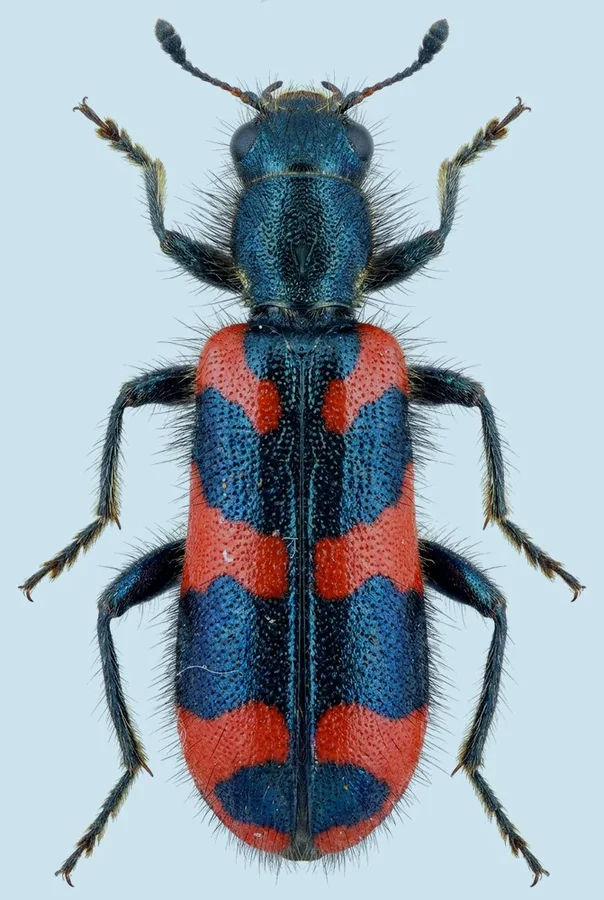
Checkered bee beetle
Its larvae live inside bee and wasp nests preying on the grubs, while the harmless adults spend their time visiting flowers.
| Where | Woodland edges, hedgerows and gardens |
|---|---|
| Size | 10 to 17 mm long |
| When | April to July |
The bee-eating beetle is a densely hairy beetle with a black head and a metallic steel blue scutellum, and red elytra crossed by black bands; a black stripe runs along the inner edge of the wing cases, and the red tip is not reached by the last black band.
Larvae develop inside the nests of solitary bees and wasps, feeding on the grubs and stored food, while the adults visit flowers such as umbellifers and rarely take flight, relying on their bold warning colours for defence.
Traits
Habitat
Garden
Colour
Metallic, Red, Black
Active
Day
To people
Harmless to people; it does not bite or sting.
Activity through the year
Often confused with
The bee beetle is smaller, from 9 to 16 mm, and its black terminal band reaches the very tip of the elytra, unlike the bee-eating beetle's plain red apex.
Questions
Is the Checkered bee beetle dangerous to people?
Harmless to people; it does not bite or sting.
When can you see the Checkered bee beetle?
The Checkered bee beetle can be seen from April to July, by day.
Plate retouched from a photo by Francisco Welter-Schultes, CC0, Wikimedia Commons Licence
Report a mistake in this entry
Beetles›Checkered beetles›Trichodes
Last updated 2026-09-26. Every entry is checked against published sources.