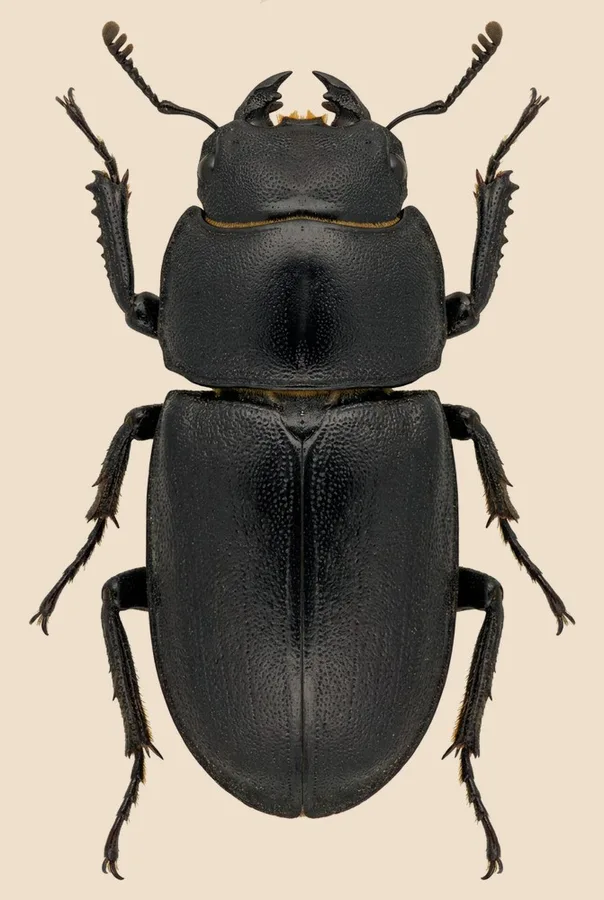
Lesser stag beetle
Despite its intimidating jaws, the lesser stag beetle cannot bite hard enough to hurt a person and spends most of its life as a larva in rotting wood.
| Where | Deciduous woodland, hedgerows, old orchards |
|---|---|
| Size | 18 to 32 mm long |
| When | May to September |
It is entirely black and glossy, with a broad head and short jaws that lack the branched antlers of the true stag beetle. Males have slightly larger, knobbed jaws and a wider head than females.
Both larvae and adults live in soft, decaying wood of broadleaved trees such as ash, beech and apple, and the grubs can take a few years to develop before becoming adults.
Traits
Habitat
Woodland
Colour
Black
Active
Night
To people
Harmless; the jaws are too weak to hurt a person.
Activity through the year
Often confused with
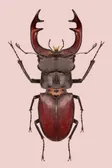
Female European stag beetles are larger, from 30 to 50 mm, with two small bumps on the forehead, while lesser stag beetles rarely exceed 32 mm and both sexes look alike.
Questions
Is the Lesser stag beetle dangerous to people?
Harmless; the jaws are too weak to hurt a person.
When can you see the Lesser stag beetle?
The Lesser stag beetle can be seen from May to September, at night.
Plate retouched from a photo by Francisco Welter-Schultes, CC0, Wikimedia Commons Licence
Report a mistake in this entry
Last updated 2026-09-26. Every entry is checked against published sources.