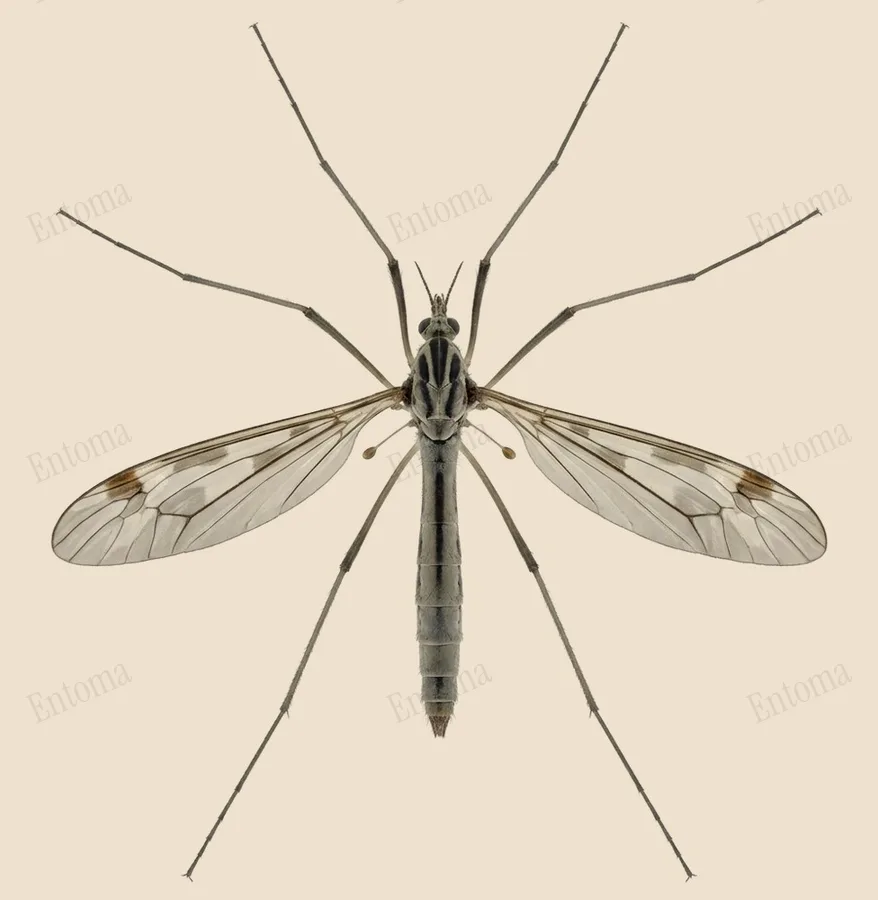
Black-striped cranefly
This cranefly's females carry unusually short, blunt tail tips instead of the long pointed cerci typical of nearly every other crane fly.
| Where | Damp grassland and open woodland |
|---|---|
| Size | 13 to 15 mm body length |
| When | April to June |
This cranefly has a yellow brown abdomen crossed by a dark stripe, orange legs that darken toward black at the tip, and shining green eyes. Dark streaks run along the wings from base to tip, with small pale marks nearer the wingtip.
Larvae feed on the roots of grasses in damp grassland and open woodland, and adults appear in spring. It tolerates disturbed ground and can turn up in parks and gardens as well as wilder sites.
Traits
Habitat
Grassland
Colour
Yellow, Brown
Active
Day and night
To people
Harmless; does not bite or sting and is not attracted to food or drinks.
Activity through the year
Often confused with
Similar in general shape but lacks the bold dark stripe down the abdomen, and the female has the long pointed tail tip typical of most crane flies rather than the blunt tip of Tipula vernalis.
Questions
Is the Black-striped cranefly dangerous to people?
Harmless; does not bite or sting and is not attracted to food or drinks.
When can you see the Black-striped cranefly?
The Black-striped cranefly can be seen from April to June, by day and at night.
Plate retouched from a museum specimen photo by Esko Viitanen, Finnish Biodiversity Information Facility, CC BY 4.0, GBIF Licence
Report a mistake in this entry
Last updated 2026-09-26. Every entry is checked against published sources.