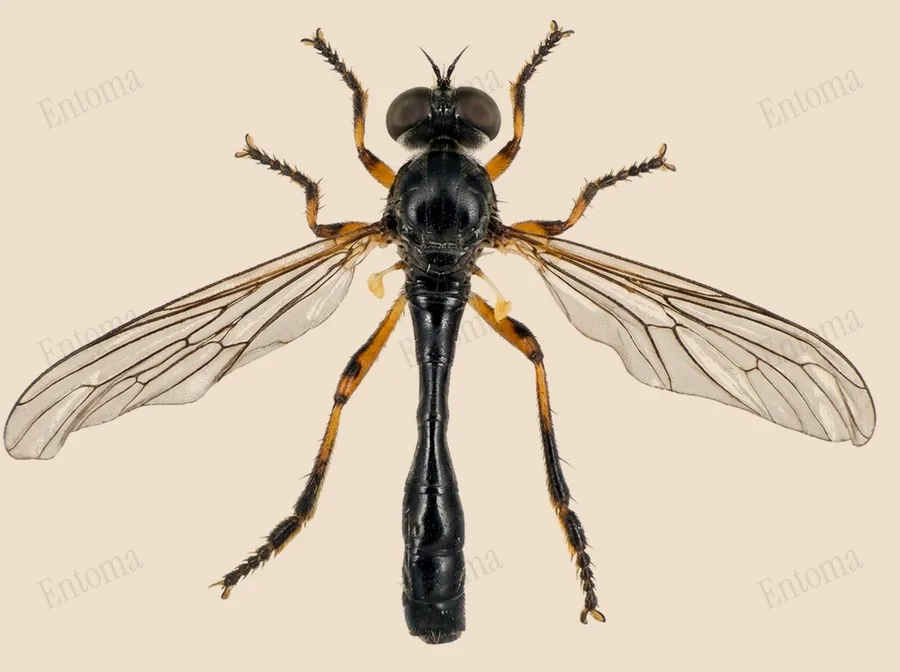
Stripe-legged robber fly
This robber fly hunts small bees and wasps such as Lasioglossum and Hylaeus, snatching them from the air or off nearby vegetation.
| Where | Woodland edges and hedgerows |
|---|---|
| Size | 10 to 14 mm body length |
| When | May to July |
This slender robber fly has a shining black head and abdomen with pale lines along the segment edges, a silvery white lower face, and legs that are mostly yellow with black markings, except for the all black hind legs.
Adults perch on low vegetation at woodland edges and hedgerows, darting out to catch small bees, wasps, and flies in midair or off nearby leaves. It flies for a short season from late spring into summer.
Traits
Habitat
Woodland
Colour
Black, Yellow
Active
Day
To people
Does not sting; may give a sharp bite in self defense if handled, though this is rare.
Activity through the year
Often confused with
Similar size at about 8 to 15 mm, but with front legs that are entirely orange red rather than yellow marked with black, and hind legs that are mostly black.
Questions
Is the Stripe-legged robber fly dangerous to people?
Does not sting; may give a sharp bite in self defense if handled, though this is rare.
When can you see the Stripe-legged robber fly?
The Stripe-legged robber fly can be seen from May to July, by day.
Plate retouched from a museum specimen photo by Gunnar Engan, Norwegian Biodiversity Information Centre, CC BY 4.0, GBIF Licence
Report a mistake in this entry
Last updated 2026-09-26. Every entry is checked against published sources.