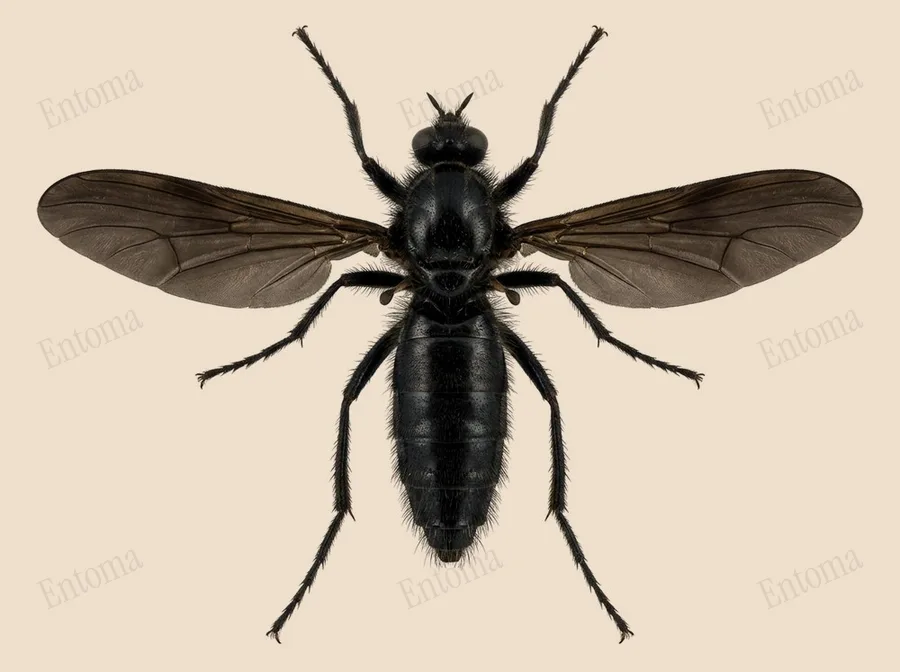
Hawthorn fly
Its emergence each spring clusters so tightly around the same date that it takes its name from a saint's day, not from hawthorn blossom.
| Where | Woodland edges and hedgerows |
|---|---|
| Size | 12 to 14 mm long |
| When | April to May |
This hairy black fly has a stout, segmented body, with males showing large bulbous eyes and long trailing legs dangled beneath them in slow, hovering flight; males reach about 12 mm and females about 14 mm long.
Larvae develop in soil and leaf litter feeding on decaying plant matter, and adults emerge in a brief mass swarm each spring around woodland edges, hedgerows, and rough grassland.
Traits
Habitat
Grassland
Colour
Black, Grey
Active
Day
To people
Harmless; it does not bite or sting, though its brief swarms can be a nuisance.
Activity through the year
Often confused with
The fever fly is much smaller at only 4 to 6 mm long and flies over most of the year from March to October, rather than in the hawthorn fly's short spring burst.
Questions
Is the Hawthorn fly dangerous to people?
Harmless; it does not bite or sting, though its brief swarms can be a nuisance.
When can you see the Hawthorn fly?
The Hawthorn fly can be seen from April to May, by day.
Plate retouched from a photo by Wilhelm Zimmerling PAR, CC BY‑SA 4.0, Wikimedia Commons Licence
The plate on this page is shared under the same licence as its source, CC BY-SA.
Report a mistake in this entry
Last updated 2026-09-26. Every entry is checked against published sources.