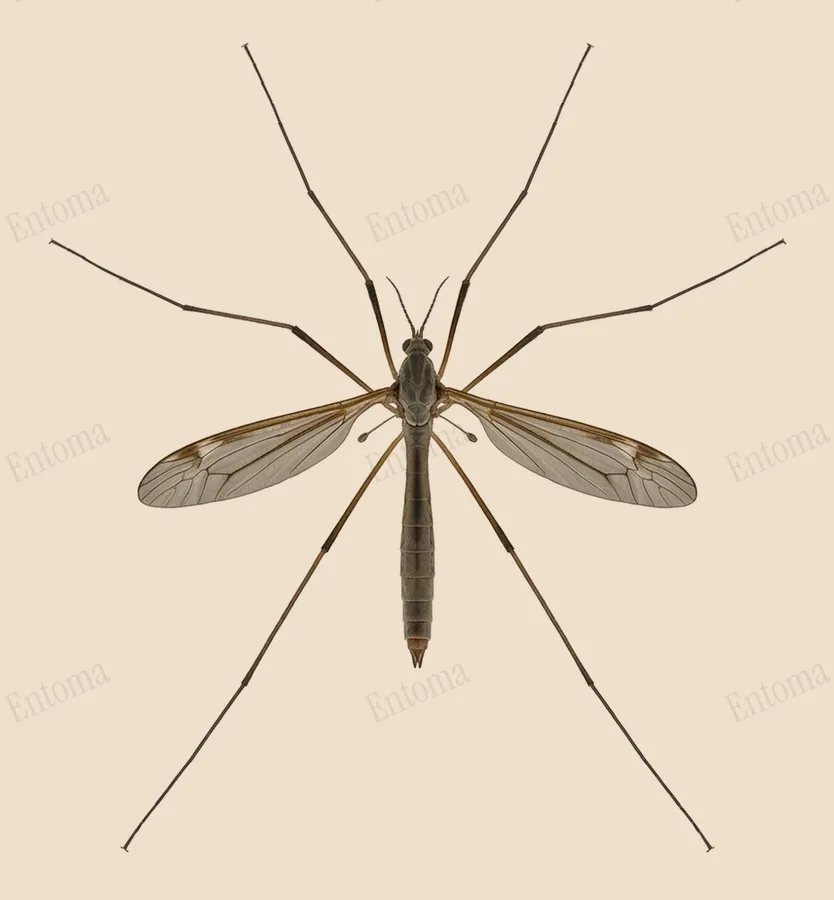
European crane fly
Despite its spindly legs and fragile look, this crane fly never feeds as an adult, living only about two weeks on stored reserves just long enough to mate.
| Where | Lawns, pastures and grassy fields |
|---|---|
| Size | 15 to 25 mm body length |
| When | May to October |
The European crane fly is a large, greyish brown fly with very long thin legs that break off easily, a weak fluttering flight, and females carrying a pointed egg laying tube at the abdomen tip.
Adults rest on vegetation by day and become active around dusk, living only about two weeks without feeding, while their tough skinned larvae, called leatherjackets, spend the following months underground feeding on grass roots.
Traits
Habitat
Grassland
Colour
Brown, Grey
Active
Night
To people
Does not bite or sting people, despite sometimes being mistaken for a giant mosquito.
Activity through the year
Often confused with
Similarly large, but with much narrower spacing between the eyes and, in females, wings that are clearly longer than the abdomen.
Questions
Is the European crane fly dangerous to people?
Does not bite or sting people, despite sometimes being mistaken for a giant mosquito.
When can you see the European crane fly?
The European crane fly can be seen from May to October, at night.
Plate retouched from a photo by Donald Hobern from Copenhagen, Denmark, CC BY 2.0, Wikimedia Commons Licence
Report a mistake in this entry
Last updated 2026-09-26. Every entry is checked against published sources.