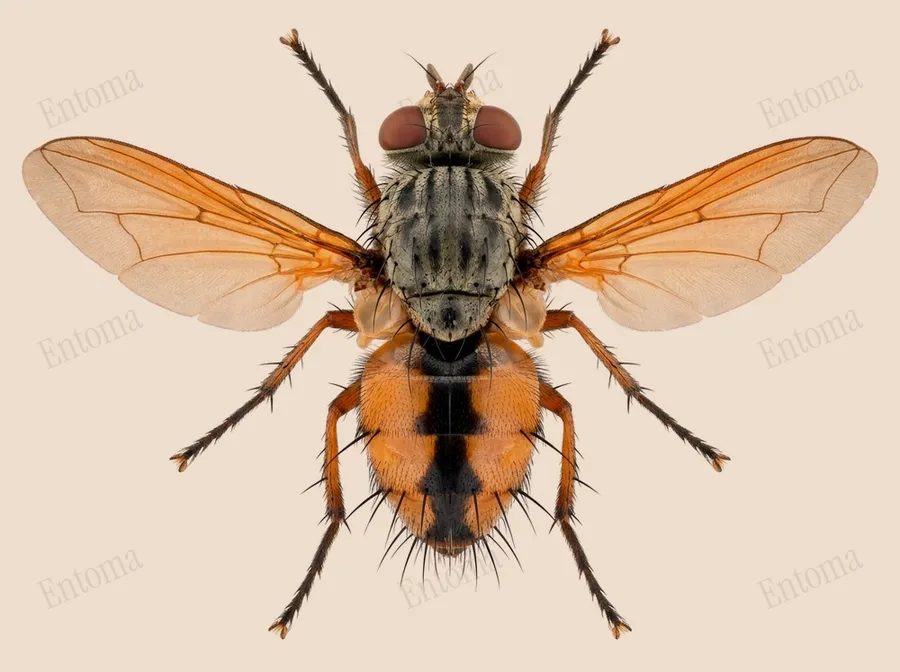
Common tachinid
It lays its eggs directly onto living caterpillars of moths such as the broom moth, and its larvae then feed inside the host until it dies.
| Where | Woodland edges and hedgerows |
|---|---|
| Size | 9 to 14 mm long |
| When | April to October |
It is a bristly grey and orange fly with a grey, black-striped thorax and an orange abdomen marked by a broad black stripe running down the middle. Close to the thorax sits a shiny orange-red bump called the postscutellum, edged with a thin black line.
Its larvae are parasitoids of noctuid moth caterpillars, including the broom moth, dun-bar and species of quaker moth, developing inside the host and killing it before pupating.
Traits
Habitat
Woodland
Colour
Orange, Black, Grey
Active
Day
To people
Harmless
Activity through the year
Often confused with
The giant tachinid is nearly twice the size at 15 to 19 mm with an all-black, inflated abdomen and yellow head, unlike the common tachinid's orange abdomen with a single black stripe.
Questions
Is the Common tachinid dangerous to people?
The Common tachinid is harmless to people.
When can you see the Common tachinid?
The Common tachinid can be seen from April to October, by day.
Plate retouched from a photo by S. Rae from Scotland, UK, CC BY 2.0, Wikimedia Commons Licence
Report a mistake in this entry
Last updated 2026-09-26. Every entry is checked against published sources.