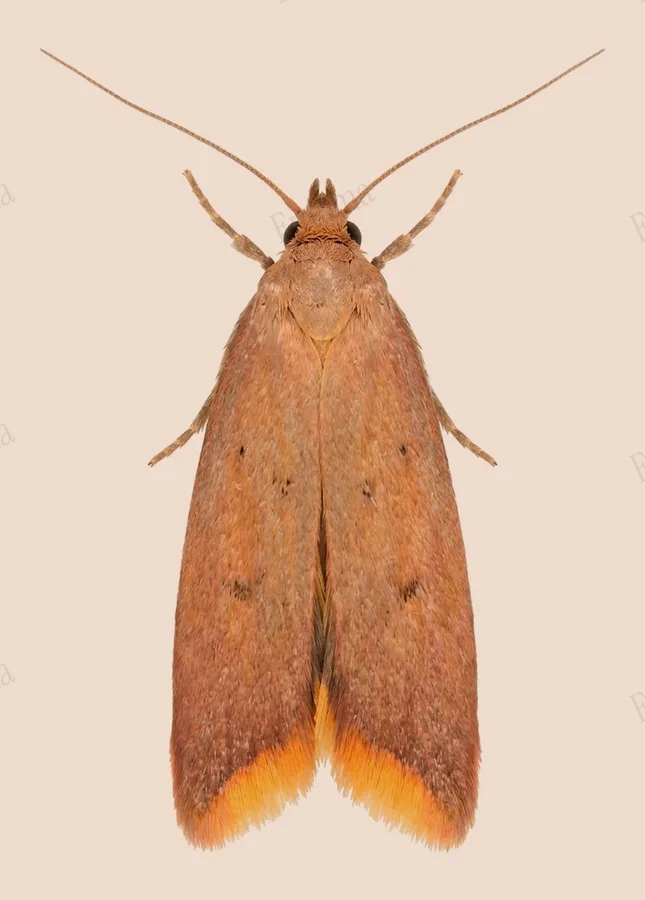
Ruddy streak
This tiny moth arrived from Australia in the early twentieth century, probably with imported plants, and its caterpillars now live in leaf litter and even household debris.
| Where | Parks, gardens and coastal scrub |
|---|---|
| Size | 13 to 15 mm wingspan |
| When | April to November |
The Ruddy Streak is a small moth with brown to purplish forewings marked with dark spots and a bright pinkish orange margin along the outer edge, a combination that makes it fairly easy to identify.
Adults fly and come to light between April and November, with no strict single generation. Caterpillars develop in decaying leaf litter and organic debris, a habit that has helped the species spread through parks, gardens and coastal scrub since its introduction from Australia.
Traits
Habitat
Garden
Colour
Brown, Orange
Active
Night
To people
Harmless to people; it is a recently established, non-native species now common in gardens.
Activity through the year
Often confused with
Similar size at 12 to 16 mm wingspan, but dark brown with pale yellow patches at the wing base and dark wingtips, and it flies by day rather than at night.
Questions
Is the Ruddy streak dangerous to people?
Harmless to people; it is a recently established, non-native species now common in gardens.
When can you see the Ruddy streak?
The Ruddy streak can be seen from April to November, at night.
Plate retouched from a photo by Ben Sale from Stevenage, UK, CC BY 2.0, Wikimedia Commons Licence
Report a mistake in this entry
Butterflies and moths›Concealer moths›Tachystola
Last updated 2026-09-26. Every entry is checked against published sources.