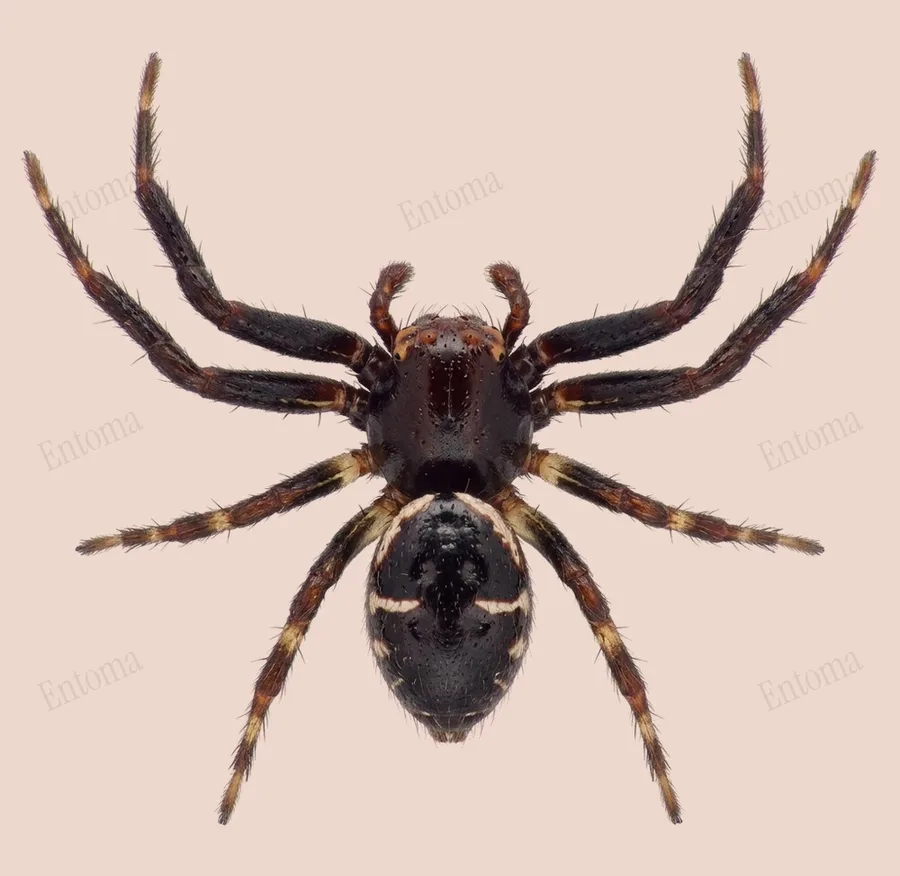
Napoleon spider
The black pattern on the female's yellow, red or white abdomen is said to resemble Napoleon's silhouette in his hat, giving this crab spider its common name.
| Where | Flowering plants in warm, open habitats |
|---|---|
| Size | Male 2 to 4 mm, female 6.8 to 8 mm body length |
| When | March to September |
Males are glossy black with a pair of white marks on the abdomen, while the much larger females carry a rounded, lens shaped abdomen in yellow, red or white marked with a bold black pattern; legs are black with brown rings in both sexes.
Like other crab spiders it spins no web, instead sitting motionless on flowering plants such as umbellifers to ambush visiting insects. It is most often found from spring through late summer across warm, open parts of its range.
Traits
Habitat
Grassland
Colour
Black, Yellow, Red
Active
Day
To people
This spider is not dangerous to people; like other crab spiders it has no reason to bite and simply drops off a flower or hides if disturbed.
Activity through the year
Often confused with
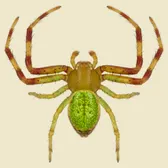
Also a small crab spider on flowers, but females have a greenish prosoma and legs rather than the black, and males show a brown abdomen with a dark bottle shaped pattern instead of the bold black on yellow, red or white Napoleon like pattern.
Questions
Is the Napoleon spider dangerous to people?
This spider is not dangerous to people; like other crab spiders it has no reason to bite and simply drops off a flower or hides if disturbed.
When can you see the Napoleon spider?
The Napoleon spider can be seen from March to September, by day.
Plate retouched from a photo by Emanuele Santarelli, CC BY‑SA 4.0, iNaturalist Licence
The plate on this page is shared under the same licence as its source, CC BY-SA.
Report a mistake in this entry
Last updated 2026-09-27. Every entry is checked against published sources.