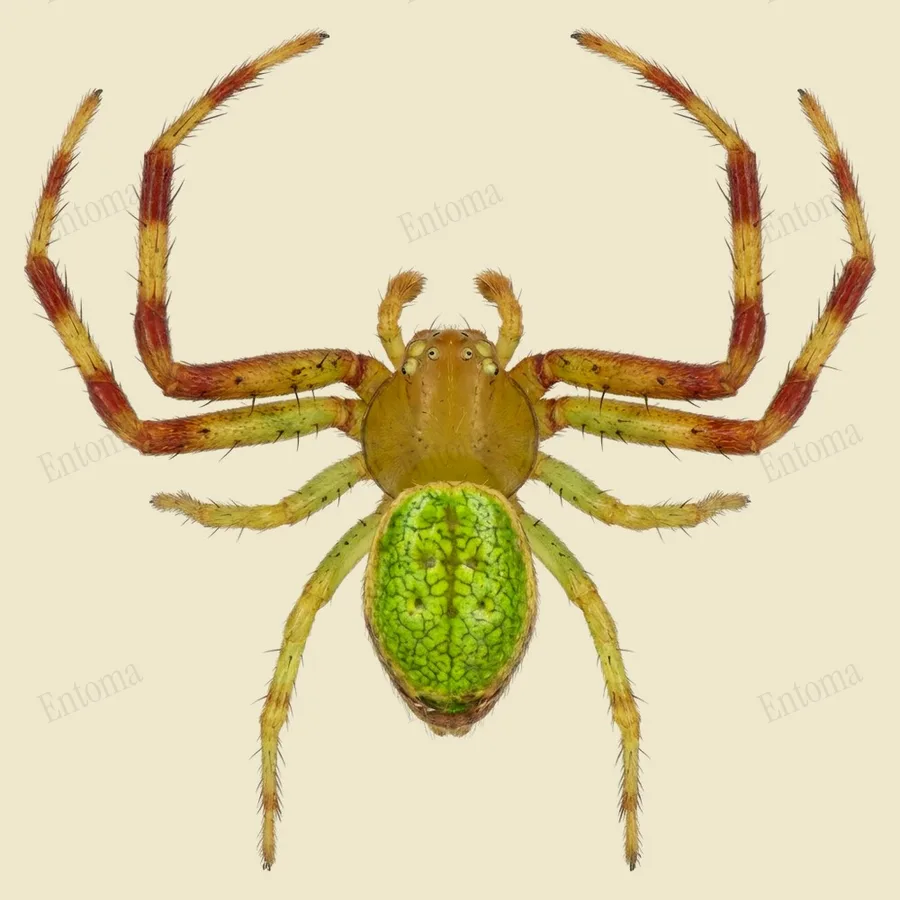
Triangle crab spider
Males and females look almost unrelated: females turn pale green and cream, while males carry a dark, bottle-shaped mark down a paler abdomen.
| Where | Dry meadows and sunny forest edges |
|---|---|
| Size | Male 2.5 to 3.5 mm, female 5 to 6 mm body length |
| When | April to October |
The triangle crab spider is a small ambush hunter of dry meadows and sunny forest edges, gripping visiting insects with its long front legs rather than spinning a web. Females are pale green with a whitish to yellowish abdomen crossed by reddish bands, while males are smaller, with a brown head marked by a pale stripe and a paler abdomen carrying a dark, bottle-shaped patch along each side.
It waits motionless on leaves and flowerheads for flies, small moths and other passing insects, then seizes them without warning. The species ranges across most of Europe and on through Turkey, the Caucasus and Central Asia to Korea, China and Japan.
Traits
Habitat
Grassland
Colour
Green, Brown
Active
Day and night
To people
Not known to bite; it stays still among leaves and flowers and rarely reacts to people at all.
Activity through the year
Often confused with
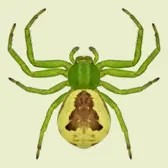
Diaea dorsata lives and hunts on the leaves of oak and other broadleaf trees rather than open meadow flowers, and its abdomen is a plain cream yellow with a single brown patch, without the bottle-shaped dark mark of the triangle crab spider.
Questions
Is the Triangle crab spider dangerous to people?
Not known to bite; it stays still among leaves and flowers and rarely reacts to people at all.
When can you see the Triangle crab spider?
The Triangle crab spider can be seen from April to October, by day and at night.
Plate retouched from a photo by Emanuele Santarelli, CC BY‑SA 4.0, iNaturalist Licence
The plate on this page is shared under the same licence as its source, CC BY-SA.
Report a mistake in this entry
Spiders›Crab spiders›Ebrechtella
Last updated 2026-09-27. Every entry is checked against published sources.