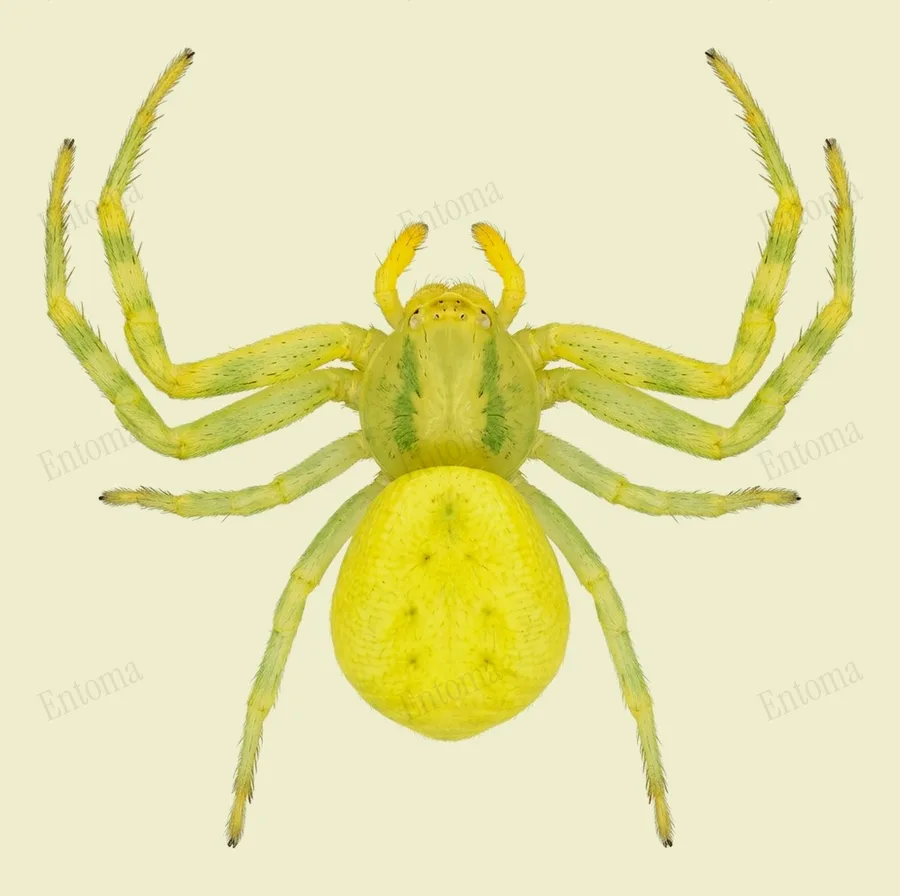
Goldenrod crab spider
This crab spider slowly changes colour between white and yellow to match its flower, and although usually a daytime hunter, it sometimes hunts moths after dark.
| Where | On flowers in meadows and forest edges |
|---|---|
| Size | Female 6 to 11.5 mm, male 3 to 5 mm body length |
| When | April to September |
Females have a broad, rounded abdomen and can slowly shift their colour between white and yellow over roughly one to three weeks to match the flower they are sitting on; males are much smaller and darker, with reddish or brown markings.
It spins no web, instead gripping a flower head and ambushing bees, flies and other visiting insects with a fast bite; it hunts mainly by day but will sometimes take prey after dark when night flying moths become more active.
Traits
Habitat
Grassland
Colour
White, Yellow, Green
Active
Day and night
To people
This spider is not dangerous to people; it has no reason to bite humans and relies entirely on camouflage to ambush insects on flowers.
Activity through the year
Often confused with
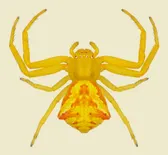
Very similar in habit and colour changing ability, but the heather crab spider has a distinctly triangular, forward pointed abdomen rather than the rounded abdomen of the goldenrod crab spider.
Questions
Is the Goldenrod crab spider dangerous to people?
This spider is not dangerous to people; it has no reason to bite humans and relies entirely on camouflage to ambush insects on flowers.
When can you see the Goldenrod crab spider?
The Goldenrod crab spider can be seen from April to September, by day and at night.
Plate retouched from a museum specimen photo by Staatliche Naturwissenschaftliche Sammlungen Bayerns, CC BY 4.0, GBIF Licence
Report a mistake in this entry
Last updated 2026-09-27. Every entry is checked against published sources.