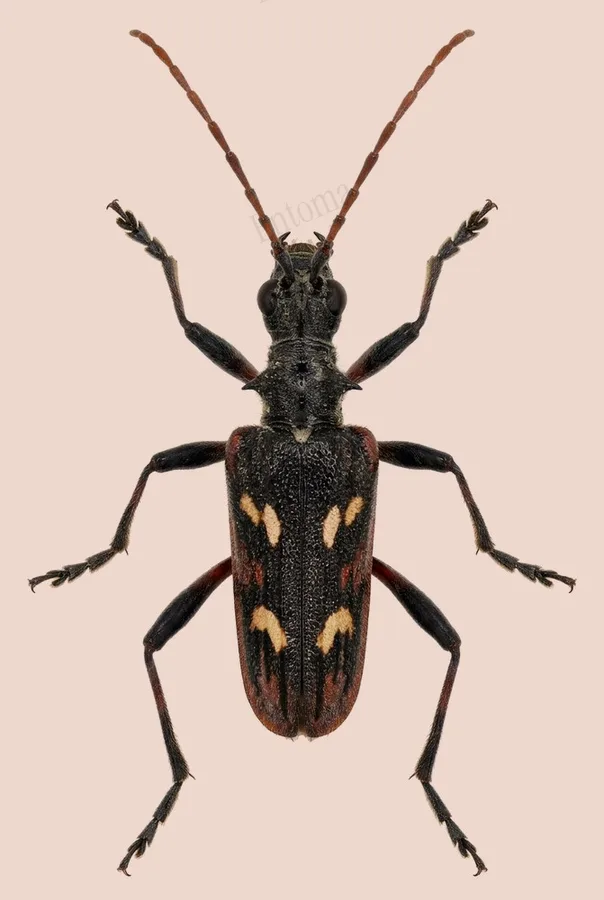
Two-banded longhorn beetle
Up to seventeen different colour patterns have been recorded in this pale-banded beetle, whose larvae take two to three years to mature inside dead wood.
| Where | Woodland, hedgerows and tree trunks |
|---|---|
| Size | 10 to 22 mm body length |
| When | April to July |
The two-banded longhorn beetle grows 10 to 22 mm long and is usually recognised by two pale yellow bands crossing each wing case, with a reddish band between them, though up to seventeen colour variants have been recorded. Adults are often found resting on tree trunks in and around woodland.
Larvae bore deep tunnels into dead and decaying wood, mostly of conifers, and take two to three years to complete their development before pupating. Adults fly from April to July and are among the most common longhorn beetles across much of Europe.
Traits
Habitat
Woodland
Colour
Brown, Yellow
Active
Day
To people
It does not bite or sting and is harmless to handle.
Activity through the year
Often confused with
Similar in size at 13 to 22 mm, but lacking the four well-defined pale spots of the Two-banded longhorn beetle, showing instead a single darkish spot along each side margin.
Questions
Is the Two-banded longhorn beetle dangerous to people?
It does not bite or sting and is harmless to handle.
When can you see the Two-banded longhorn beetle?
The Two-banded longhorn beetle can be seen from April to July, by day.
Plate retouched from a photo by Francisco Welter-Schultes, CC0, Wikimedia Commons Licence
Report a mistake in this entry
Beetles›Longhorn beetles›Rhagium
Last updated 2026-09-26. Every entry is checked against published sources.