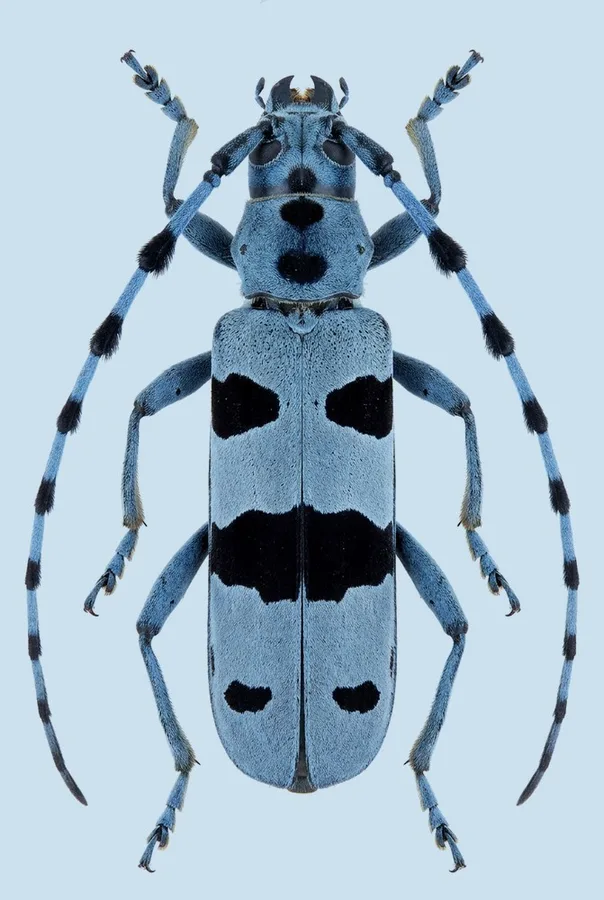
Rosalia longicorn
Males of this striking blue-grey longhorn beetle grow antennae twice the length of their own body, tufted with black hairs, and adults chirp if disturbed.
| Where | Old sun-exposed beech forests |
|---|---|
| Size | 15 to 38 mm body length |
| When | June to September |
The Rosalia longicorn is a large, unmistakable beetle with pale blue-grey wing cases marked by black spots, including a prominent patch on the thorax and further spots near the front and back of each wing case. Males carry antennae up to twice their body length, tufted with black hairs, while females have shorter, thicker antennae.
Adults sit and feed on pollen near flowers by day in old, sun-exposed beech forests, producing a chirping sound by rubbing body parts together when disturbed. Females lay eggs in cracks in dead or dying beech bark, and larvae develop in the wood for several years before pupating.
Traits
Habitat
Woodland
Colour
Blue, Grey, Black
Active
Day
To people
A protected species in several European countries because it depends on old-growth beech forest; harmless to people.
Activity through the year
Often confused with
Similar in length at about 15 to 40 mm, but broader-bodied and uniformly dark with grayish-brown hair and grainy wing cases, lacking the pale blue-grey background and sharp black spots of the Rosalia longicorn.
Questions
Is the Rosalia longicorn dangerous to people?
A protected species in several European countries because it depends on old-growth beech forest; harmless to people.
When can you see the Rosalia longicorn?
The Rosalia longicorn can be seen from June to September, by day.
Plate retouched from a photo by Francisco Welter-Schultes, CC0, Wikimedia Commons Licence
Report a mistake in this entry
Beetles›Longhorn beetles›Rosalia
Last updated 2026-09-26. Every entry is checked against published sources.