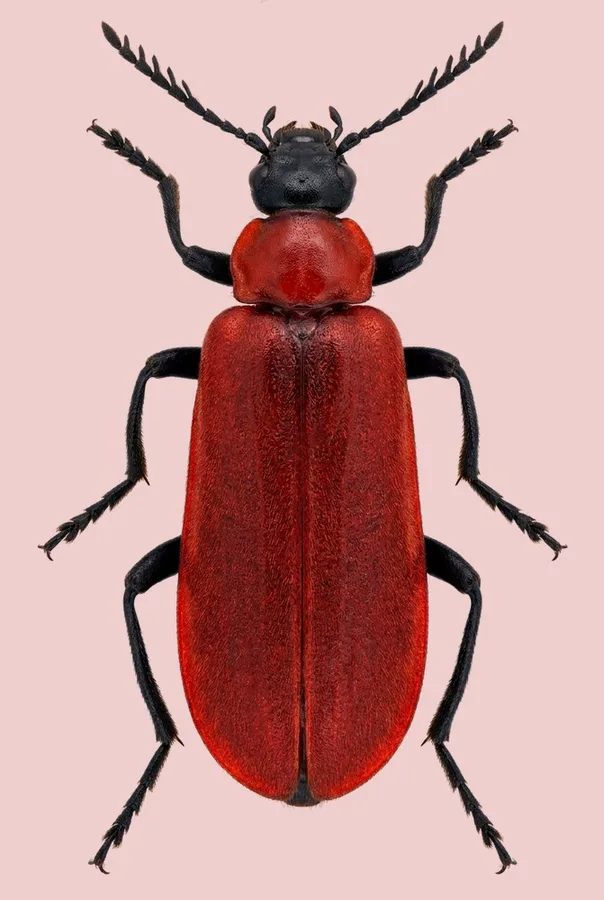
Cardinal beetle
Its larvae can spend several years hidden under bark before an adult finally emerges, and crowded larvae will sometimes turn cannibalistic.
| Where | Woodland with dead timber |
|---|---|
| Size | 14 to 20 mm long |
| When | April to June |
It has a shiny scarlet thorax and wing cases set against an all-black head, legs and antennae, and its antennae are broadly comb-toothed rather than simple threads. It is a fairly large, flattened beetle that moves openly over foliage and tree trunks in daylight.
The larvae develop under the loose bark of dead or dying broadleaved trees such as oak and beech, feeding on decaying wood tissue, fungi and other insects for a year or more before pupating in spring.
Traits
Habitat
Woodland
Colour
Red, Black
Active
Day
To people
Harmless
Activity through the year
Often confused with
The red-headed cardinal beetle has a red head rather than black, and its body of 10 to 18 mm runs smaller on average than the black-headed species' 14 to 20 mm.
Questions
Is the Cardinal beetle dangerous to people?
The Cardinal beetle is harmless to people.
When can you see the Cardinal beetle?
The Cardinal beetle can be seen from April to June, by day.
Plate retouched from a photo by Francisco Welter-Schultes, CC0, Wikimedia Commons Licence
Report a mistake in this entry
Beetles›Fire-coloured beetles›Pyrochroa
Last updated 2026-09-26. Every entry is checked against published sources.