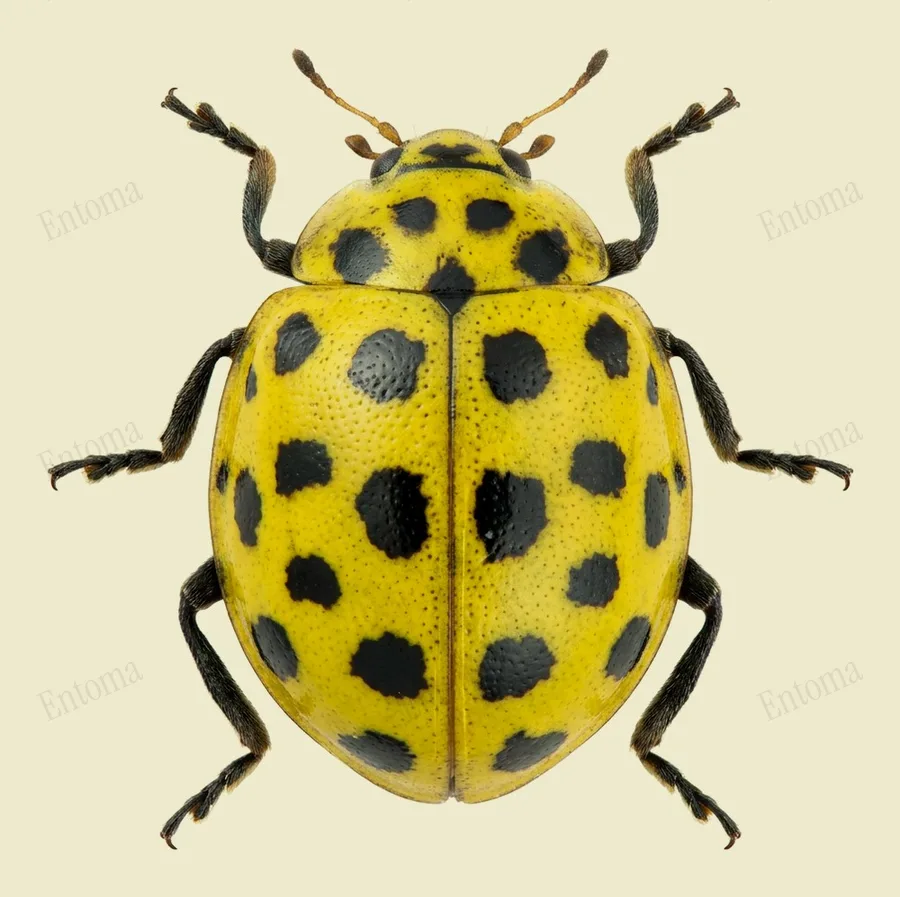
22-spot ladybird
Unlike almost every other ladybird, it eats mildew rather than aphids, grazing fungal growth straight off leaf surfaces.
| Where | Grassland, roadside verges, low vegetation |
|---|---|
| Size | 3 to 4.5 mm body length |
| When | April to October |
A very small, rounded ladybird with lemon yellow wing cases marked by up to 22 black spots.
Both adults and larvae graze on powdery mildew on low plants, and adults overwinter among leaf litter or tussocky grass rather than in large clusters.
Traits
Habitat
Grassland
Colour
Yellow, Black
Active
Day
To people
Harmless
Activity through the year
Often confused with
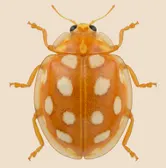
Orange ladybird is larger, around 6 mm, with an orange background colour and pale cream spots, rather than yellow with black spots.
Questions
Is the 22-spot ladybird dangerous to people?
The 22-spot ladybird is harmless to people.
When can you see the 22-spot ladybird?
The 22-spot ladybird can be seen from April to October, by day.
Plate retouched from a photo by Gilles San Martin, CC BY‑SA 4.0, Wikimedia Commons Licence
The plate on this page is shared under the same licence as its source, CC BY-SA.
Report a mistake in this entry
Last updated 2026-09-26. Every entry is checked against published sources.