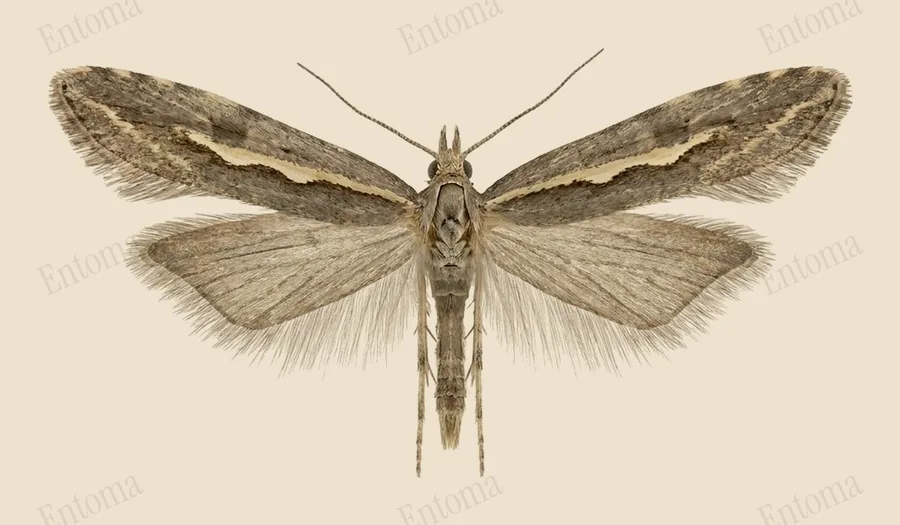
Diamondback moth
Despite being a weak flier barely a centimetre across, this moth is regularly swept thousands of kilometres on the wind, making it one of Earth's most widespread insects.
| Where | Farmland and gardens with cruciferous plants |
|---|---|
| Size | 12 to 15 mm wingspan |
| When | May to October |
The Diamondback moth is small and slender, with grey-brown forewings that form three pale, triangular diamond shapes along the back when the wings are folded at rest. It is most active after dark.
Two or more generations fly between May and October in cooler climates, with continuous breeding possible where winters are mild. Caterpillars feed on cabbage, oilseed rape and other cruciferous plants, occasionally reaching pest numbers on farms.
Traits
Habitat
Farmland
Colour
Brown, Grey
Active
Night
To people
Attracted to light at night; poses no known risk to people.
Activity through the year
Often confused with
A close 14 to 17 mm wingspan, but with longitudinal streaks along the forewing rather than triangular diamonds, and three dark rings near the antenna tips.
Questions
Is the Diamondback moth dangerous to people?
Attracted to light at night; poses no known risk to people.
When can you see the Diamondback moth?
The Diamondback moth can be seen from May to October, at night.
Plate retouched from a photo by Hsu Hong Lin from 南投縣集集鎮, 中華民國, CC BY 2.0, Wikimedia Commons Licence
Report a mistake in this entry
Butterflies and moths›Diamondback moths›Plutella
Last updated 2026-09-26. Every entry is checked against published sources.