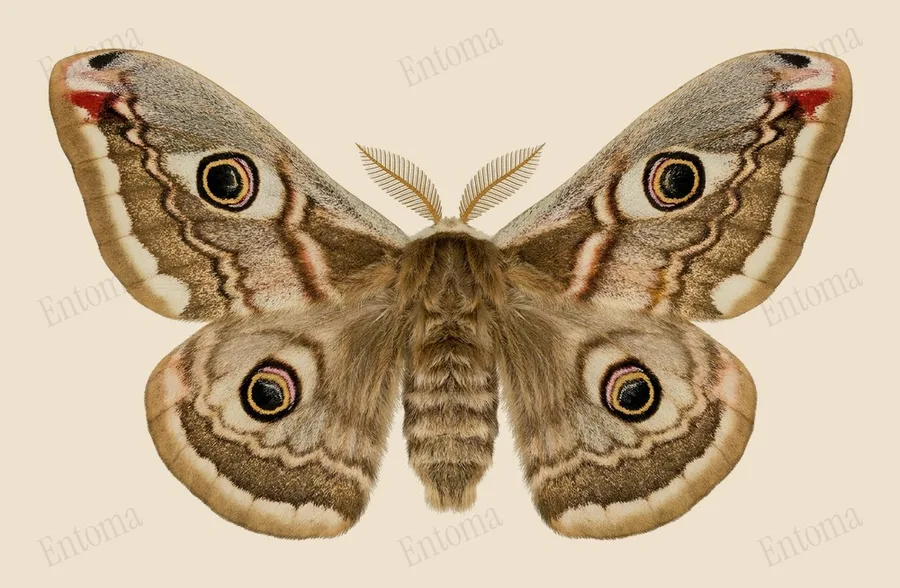
Emperor moth
Male emperor moths fly by day using large feathery antennae to detect a female's scent from up to several kilometres away.
| Where | Heathland, moorland and open scrub |
|---|---|
| Size | 40 to 60 mm wingspan |
| When | April to May |
The male Emperor moth has orange hindwings and grey brown forewings, each marked with a large eyespot, and flies fast in sunshine. The female is bulkier and greyer with the same eyespot pattern, and flies only at night.
Both sexes are on the wing from April to May over heathland, moorland and open scrub. The green caterpillar has black bands with yellow warts and feeds on heather, bramble and hawthorn.
Traits
Habitat
Heath
Colour
Orange, Grey
Active
Day and night
To people
Males fly by day searching for mates; harmless to people.
Activity through the year
Often confused with
Overlapping in size, with males about 45 to 70 mm and females 50 to 95 mm wingspan, but found only in Alpine and southeastern parts of Europe rather than the wider range of the Emperor moth.
Questions
Is the Emperor moth dangerous to people?
Males fly by day searching for mates; harmless to people.
When can you see the Emperor moth?
The Emperor moth can be seen from April to May, by day and at night.
Plate retouched from a photo by Didier Descouens, CC BY‑SA 4.0, Wikimedia Commons Licence
The plate on this page is shared under the same licence as its source, CC BY-SA.
Report a mistake in this entry
Butterflies and moths›Emperor moths›Saturnia
Last updated 2026-09-26. Every entry is checked against published sources.